
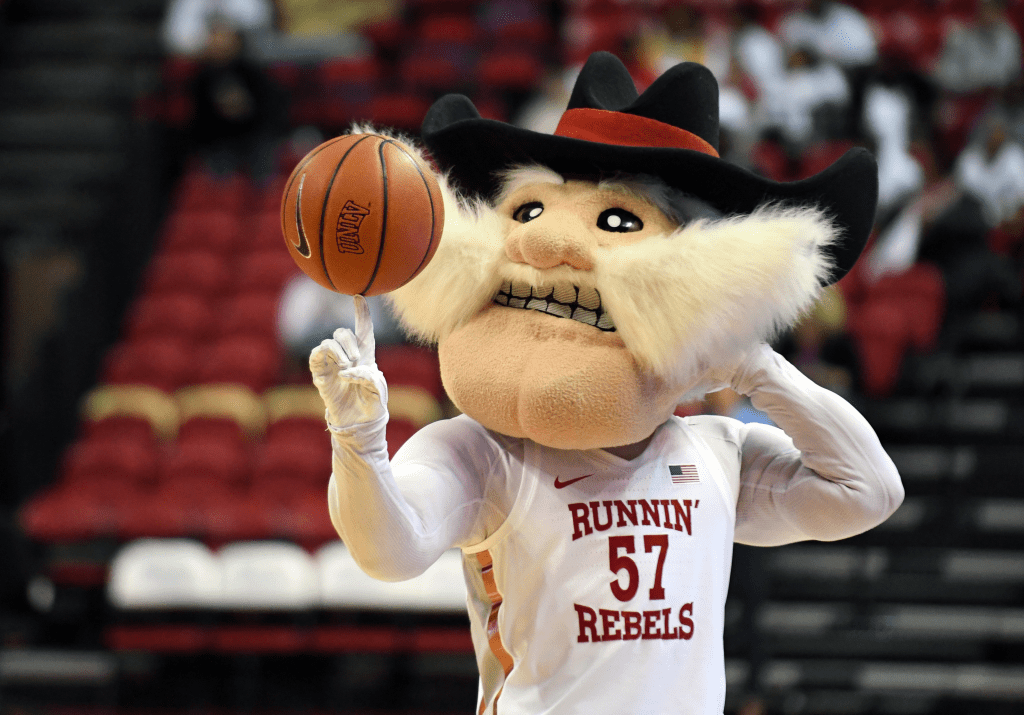
The Thomas & Mack Center still gets loud. Allegiant Stadium still looks like a sea of red on the Strip. UNLV football is rising, and the athletic department is fighting for national relevance in a city that now expects major-league energy.
But on game days, there is a visible absence.
UNLV has no live mascot on the sideline, no character leading cheers, no figure turning the student section into a stage, no recognizable “face” that bridges families, students, and alumni into a single identity. For many fans, that missing element has become as noticeable as anything on the scoreboard.
That absence is why the campaign to restore Hey Reb, UNLV’s retired mascot, has accelerated again. A Change.org petition calling for his return, authored by this reporter, has surpassed 1,500 verified signatures, with supporters describing a loss that is emotional, cultural, and measurable in how people attend, spend, and engage.
“Rebels need a Rebel to rally behind,” said Carter Wilkerson, a current UNLV dental student.
The debate has returned to public view through newspaper coverage, social media, and radio discussion. But supporters say one claim keeps resurfacing that doesn’t align with the people actually speaking up: that the Hey Reb movement is driven only by nostalgia, alumni wanting to relive the past, rather than students, families, and stakeholders advocating for the present.
“It’s not just personal memories,” Wilkerson said. “It’s school spirit, branding, recruiting, and community engagement, the things universities rely on to grow.”
The Why Behind HeyReb! The Reason He Was Created
Hey Reb debuted in 1982 as a deliberate break from UNLV’s earlier mascot, Beauregard the Wolf, which had worn Confederate imagery. That imagery had already been eliminated in the 1970s, and the university sought a symbol that reflected independence and the Western identity of Southern Nevada without Confederate ties.
Hey Reb was designed as a frontiersman, a mountain man meant to embody the “Rebel” spirit as individuality and defiance, not Civil War symbolism.
That distinction was formally addressed in a university-commissioned report in 2015, which concluded that neither the Rebels’ nickname nor the term “Hey Reb” had any Confederate connection.
Yet amid national unrest in 2020, UNLV removed the Hey Reb statue from campus and formally retired the mascot in 2021, citing concerns raised by some students and community members. The university kept the Rebels’ name and its scarlet-and-gray color scheme.
For supporters, that inconsistency remains one of the clearest signs that the decision was rushed and disconnected from the broader UNLV community.
“It felt inconsistent and poorly thought out,” Wilkerson said. “They removed Hey Reb but kept the Rebels name and the red color scheme. If the mascot was the problem, why keep everything else?”
“I Loved Going To Games Just To See Hey Reb.”

For many supporters, Hey Reb is not a political argument. He is an entry point, especially for kids.
J.C. Carr was born and raised in Las Vegas. His parents attended UNLV. His family has held basketball and football season tickets since he was born.
“We have had season tickets to basketball and football since I was born,” Carr said. “I grew up my entire life attending games.”
His first UNLV memory wasn’t even in the arena. It was watching UNLV upset No. 1 North Carolina in 2011 when he was 6 years old.
“I remember thinking that because UNLV beat the team with the number one in front of their name, it meant UNLV was actually the number one team now,” Carr said.
But his strongest memories weren’t tactical or analytical.
“As someone who grew up going to games at such a young age, I realize that kids love attending games for the theatrics,” Carr said. “Most of all, I loved going to the games just to see Hey Reb.”
Carr said he begged for photos, made mustache cutouts in school, and associated the mascot with joy.
“I couldn’t imagine attending games as a child now without a Hey Reb there to make you smile,” he said. “Having a mascot gives a university identity. Without one, UNLV is missing that personable engagement.”
“He Felt Like A Natural Extension of the Crowd”
Dylan Rice, whose parents attended UNLV in the 1990s, described his earliest UNLV memories as emotional rather than statistical.
“My earliest UNLV game memory isn’t tied to a specific score or season,” Rice said. “It’s the feeling of being in the crowd, surrounded by red, noise, and energy.”
“Hey Reb!” he said, was part of that feeling.
“He felt like a natural extension of the crowd rather than a symbol imposed on it,” Rice said.
That distinction matters, supporters argue, because it reframes the debate from nostalgia to experience.
A Fanbase Beyond Las Vegas
Nick Osucko’s connection to UNLV began far from campus.
In the late 1980s, he watched UNLV on Southern California television, then attended games at Cal State Fullerton, Long Beach State, UC Irvine, and UC Santa Barbara.
His first in-person memory: “1989 watching UNLV run up and down the court throwing alley-oops.”
Osucko said Hey Reb gave UNLV instant identity.
“When I heard the news about Hey Reb not coming back, I was sad,” he said. “Hey Reb was one of the best-looking mascots in all of college sports.”
He also pushed back on how the mascot is often mischaracterized.
“People most often get it wrong that Hey Reb is a guy with a gun or a racist mascot, which is not true by any means,” Osucko said.
“A Symbol of Vegas Itself”
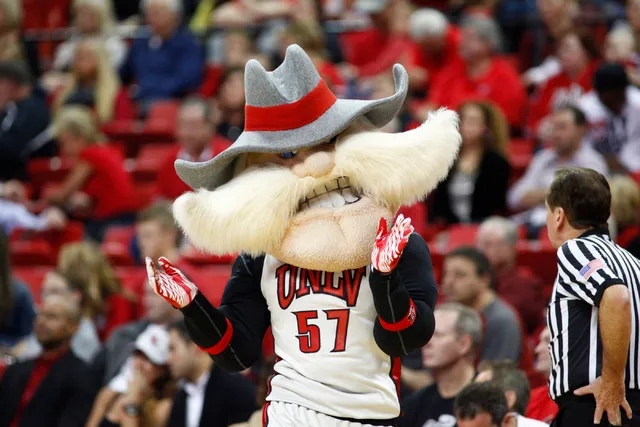
Some supporters never attended UNLV. Cody Tomboli, a longtime Las Vegas resident, said Hey Reb always felt like a city symbol.
“For the 18 years I’ve lived here, Hey Reb felt like a symbol of Vegas itself, rebellious, confident, and unapologetic,” Tomboli said. “I never saw it as something tied to the Confederacy.”
Tomboli said the timing of Hey Reb’s retirement matters.
“In 2021, a lot of decisions were made when everything was under a microscope,” he said. “Retiring Hey Reb felt more like a reaction to the moment than a reflection of how most fans experienced him.”
Season Ticket Holders: Behavior, Not Opinion
Supporters point not just to emotion, but to behavior.
“I got rid of my season tickets when you did away with OUR Hey Reb!!!” wrote Todd Henderson in a petition comment.
Reign, a basketball season ticket holder since 2008 and a football season ticket holder since 2024, said the impact became clearer only after the mascot was gone.
“I truly did not appreciate the impact the loss would have,” he said.
RebelReign said his children loved seeing Hey Reb, high-fiving him, and taking pictures with him.
“He always brought joy and energy,” he said. “He was more mobile than most mascots, just a head and minimal elements, and he connected with fans.”
RebelReign rejected the idea that this debate is ideological.
“This is not liberal versus conservative,” he said. “I am a proud Democrat, former president of the UNLV Young Democrats, and I’m passionate about bringing back Hey Reb.”
He added that Hey Reb’s brand value matters. “His brand identity is worth many millions,” Reign said. “He’s a recruiting tool. The kids love him.”
Current Students, Not Just Alumni
One of the most common criticisms of the movement is that it does not represent enrolled students. Carter Wilkerson’s story directly challenges that narrative.
Wilkerson grew up a UNR fan and openly disliked UNLV before attending dental school.
“That came with a pretty automatic hatred for UNLV,” he said. That changed after moving to Las Vegas. “I fell in love with the energy of the city and the sense of community at UNLV,” he said. “I proudly chose to #BeaRebel.”
Wilkerson attended his first UNLV football game alone in 2023.
“A couple invited me to sit in their season-ticket seats and treated me like family,” he said. Wilkerson previously served as a collegiate mascot at the University of San Diego. “I saw firsthand how powerful a mascot can be,” he said. “Kids light up instantly.”
The Radio Debate And The Nostalgia Claim
The issue resurfaced publicly during a local radio segment following a Review-Journal article. On air, Matilda Guerrero Miller, a UNLV alumna, argued against reinstating Hey Reb, saying the push was driven by nostalgia and branding rather than current students.
Supporters dispute that characterization; not by dismissing her perspective, but by pointing to the diversity of voices speaking up.
Reign attended UNLV beginning in 2000. Wilkerson is a current graduate student. Carr represents a younger generation raised in UNLV arenas. David Cho met Hey Reb during new-student orientation in 2018. Dank, known online as sergeantdank_ , grew up seeing a sea of red on the Strip and said, “Reb matters to me because that’s who Vegas is.”
Dank acknowledged he never attended UNLV due to transfer-credit issues, but still identifies with the program.
“I wear my Red Reb shirt and support UNLV even more,” he said. “We are Rebels. Cannot change that.”
The Voice From Inside The Suit
Jon “Jersey” Goldman, who portrayed Hey Reb for six years, said the experience was overwhelmingly positive.
“When it comes to the memories, it was always positive,” Goldman said. “There was really never negativity.”
Goldman said the debate persists because no replacement for the mascot has emerged.
“Everybody’s focused on rushing to argue back and forth,” he said, “instead of somebody coming up with a solution.”
What Compromise Could Look Like
Some supporters insist Hey Reb is irreplaceable. Others are open to alternatives, but not to having nothing.
Wilkerson said he would support a new mascot tied to Southern Nevada if reinstatement proves impossible.
“Any mascot is better than no mascot,” he said. Reign said compromise would require something “truly spectacular.” Dank suggested allowing a new logo option that reflects Rebel identity without added stress.
The Message To Leadership
Across generations, perspectives, and backgrounds, the message converges on identity, process, and accountability.
“UNLV has the colors. The name. The history,” Reign said. “What we’re missing is the face.”
Until UNLV provides a clear path forward for reinstatement, replacement, or a formal vote, supporters say the debate will continue.
Because for many, a Rebel without a mascot is still a Rebel without a face.
Leave a Reply