

LAS VEGAS — College basketball seasons are rarely defined by one game. They are defined by patterns.
And if you’ve been inside the Thomas & Mack Center this year, you’ve felt the pattern. The runs. The collapses. The controlled nights. The unraveling ones.
The problem for UNLV this season has not been effort. It has not been talent. It has not even been scoring.
It has been volatile.
The Rebels enter Tuesday night’s matchup against the San José State Spartans at 11-12 overall and 6-6 in Mountain West play. That record does not tell the full story. The deeper story lives in the margins, in the swings between controlled wins and unraveling losses.
Fans don’t need a spreadsheet to feel that. They’ve lived it. They’ve watched double-digit leads evaporate. They’ve watched hot shooting nights still end in frustration.
Head coach Josh Pastner has framed it in simpler language.
“Mission accomplishment is more important than personal comfort,” he said Sunday on the Reb Zone. Sprint back. Make multiple efforts. Defend without fouling. Finish possessions.
Underneath that message is a simple truth: UNLV wins when it controls possessions. It loses when it does not.
That is not motivational rhetoric. It is measurable.
And it is exactly why Saturday’s Grand Canyon win has become the central fan question heading into Tuesday: momentum or a fluke? A turn of the corner or just another spike on the rollercoaster?
Is this the start of something or just another chapter in the swings?
The Pattern Beneath the Record
When the Rebels wins, the statistical profile is decisive:
- 86.6 points per game
- 48.8% field goal shooting
- 35.4% from three
- 75.2% at the free-throw line
- 40.4 rebounds per game
- +6.8 rebound margin
- 11.4 turnovers
- +3.3 turnover margin
- 20.6 personal fouls
When the Rebels lose, it flips on its head:
- 71.6 points per game
- 43.4% field goal shooting
- 29.8% from three
- 64.1% free throws
- 31.3 rebounds
- -3.9 rebound margin
- 14.1 turnovers
- -3.8 turnover margin
- 24.5 personal fouls
There is almost no middle ground. The scoring margin reflects that:
- +16.3 in wins
- -14.9 in losses
UNLV does not live in coin-flip basketball. It either establishes control or loses it.
And that’s why so many fans feel uneasy even after wins. The separation is dramatic. The swings are dramatic. There’s rarely a quiet, steady night.
That is why Tuesday’s game matters beyond its place in the standings. It is a test of repeatability and a direct response to the fan anxiety that has followed this team for months:
Which UNLV shows up? The one that looks connected for 40 minutes? Or the one that drifts for five and lets everything unravel?
Grand Canyon: Fluke or Foundation?
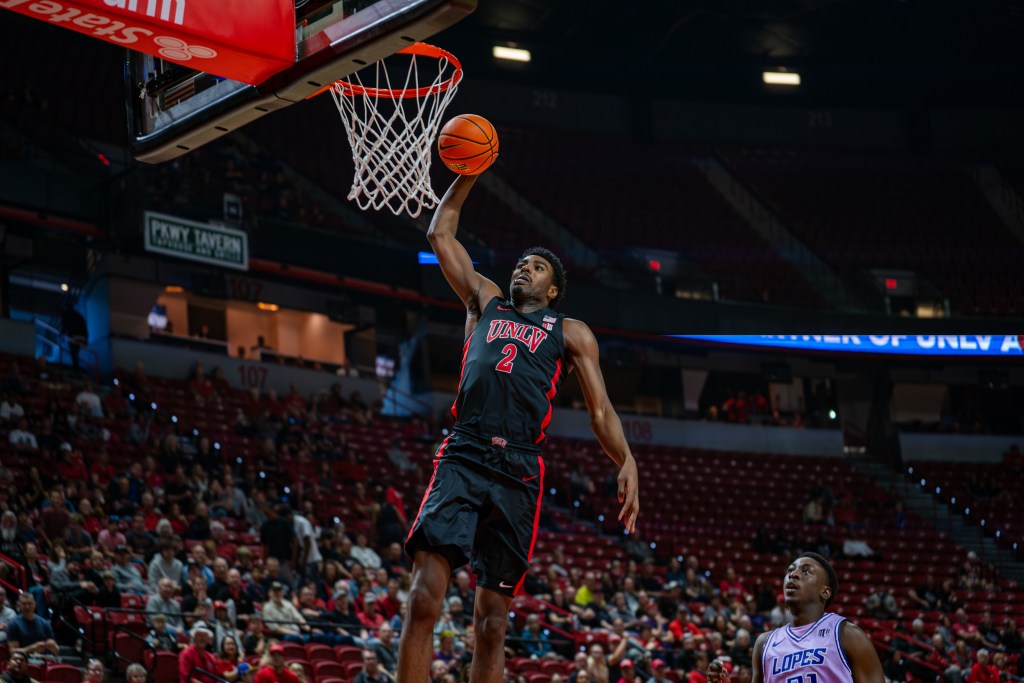
Saturday mattered because it looked like a break in the pattern, not because it was perfect, but because it was functional.
The Rebels beat Grand Canyon 80-78 while short-handed, surviving late pressure, and finishing possessions with the discipline that has been absent too often in losses. It wasn’t pretty. It wasn’t smooth. But it held.
And that matters to a fan base that has been waiting to see a game close without chaos.
But fan skepticism is earned. This season includes wins that prove UNLV can play at a high level and losses that prove it can fall through the floor.
That’s what makes Tuesday dangerous.
Because if the Grand Canyon win was “emotion and adrenaline,” it won’t travel well into the next game. If it was “structure,” it will show up again immediately in the boring places: shot selection, transition defense, rebounding, and foul control.
Momentum is not a vibe. It is repetition.
And repetition is what Rebel fans have been waiting to see.
The First Meeting Was a Blueprint
On Jan. 17 in San Jose, UNLV defeated the Spartans 76-62. The Rebels led for more than 38 minutes of game time. They shot:
- 54.0% from the field
- 47.8% from three
- 91.7% from the line
They produced 30 points in the paint and 15 points off turnovers. It was one of the most efficient offensive performances of the season.
That’s the version of this team fans point to and say, “See? That’s what they can be.”
Yet even that game contained a warning.
San José State won the rebounding battle, 31-22. The Spartans generated nine second-chance points to UNLV’s two. The Rebels were simply so efficient offensively that the possession deficit did not cost them.
That margin will be thinner Tuesday night.
And this is where the scouting report matters: San José State is not built to race you. It is built to slow you.
The Spartans play at one of the slowest tempos in the country. They want long possessions. They want you to get impatient. They want you to prove you can execute when the game feels repetitive and uncomfortable.
That is exactly the type of environment where UNLV’s volatility has shown up.
How patient will the Rebels be when the game tightens?
How loud will the building get if possessions stall late in the shot clock?
Garland Changes the Stress Points
Pastner noted that San José State’s star guard, Colby Garland, did not play in the first meeting. “He will play this week,” Pastner said.
That changes the game. Garland is not just another scorer; he’s a stabilizer for a team that otherwise struggles to generate efficient offense. He organizes possessions. He creates free throws. He forces defenders into decisions.
And that intersects with UNLV’s biggest recurring leak: fouling.
If Tuesday becomes a whistle game, the gap between “UNLV is better” and “UNLV is safe” shrinks fast.
And every fan in the building knows how quickly whistles can change the temperature of a game.
The blueprint exists. The margin for error narrows.
The Fresno Reminder
Last Tuesday’s 98-96 loss at Fresno State illustrated the volatility problem.
UNLV scored 96 points. Under most conditions, that is enough. Against Fresno, it was not. Fresno shot 59% from the field and 53% from three. Defensive discipline faltered. Fouls mounted. The final seconds dissolved into frustration.
“You can’t win at that level,” Pastner said. “We weren’t good enough defensively.”
And that’s the fear lingering in the background for fans: that even when this team scores, it can still slip.
Three consecutive games before Grand Canyon featured opponents scoring 89, 89, and 98 points. That is not sustainable in a league built on half-court discipline. Saturday’s win mattered because it looked like a partial correction. But Fresno remains the clearest caution: UNLV can play well, and still lose, if its defensive discipline collapses.
The Possession Game
Turnovers and fouls remain the clearest indicators of UNLV’s direction.
In victories, the Rebels average 11.4 turnovers. In losses, that number rises above 14. That three-possession swing translates quickly into six to eight points.
Fouls follow a similar pattern. In wins, UNLV averages just over 20 fouls. In losses, that climbs near 25. Five extra fouls often mean five extra free-throw trips. Those are repeatable leaks, not unlucky bounces.
And they’re the kinds of stretches that make an arena tense.
Pastner addressed it directly when discussing Dravyn Gibbs-Lawhorn, who has scored 20 or more in three straight games.
“He’s got to stop fouling,” Pastner said. “That cost us in Fresno.”
The emphasis is not about reducing aggression. It is about refining it.
Aggression without discipline creates volatility. Aggression within structure creates separation.
What Tuesday Represents

San José State will not attempt to overwhelm UNLV with tempo. The Spartans prefer measured possessions. They defend with patience. They test decision-making late in the shot clock.
That stylistic choice exposes bad habits, and that’s why Tuesday is the perfect litmus test for the fan questions.
If Grand Canyon was momentum, it has to show up as discipline. Not as energy. Not as highlights. Not as an early run.
Discipline.
If UNLV keeps turnovers under 12, defends without fouling, and rebounds at or near its winning average, the historical pattern suggests control. If those benchmarks slip, volatility reappears, and the crowd will feel it before the final score does.
Will this be a night where the Rebels take a double-digit lead and build on it? Or a night where every possession feels like a coin toss?
The stakes extend beyond one conference win. UNLV faces Boise State later in the week, another high-level opponent. Momentum in February is cumulative.
Pastner used the word “measured” to describe how his team must approach the week.
Measured does not mean passive. It means intentional. It means sprinting back on defense instead of jogging. It means making the extra rotation. It means converting free throws when the noise rises. It means finishing possessions with a rebound rather than conceding a second chance. It means mission accomplishment over comfort.
College basketball seasons rarely pivot on one possession. They pivot on habits. UNLV has shown it can score. It has shown it can survive. It has shown flashes of control.
Tuesday night is about demonstrating that control can be sustained. That is the real answer to the fan concern: which team will show up?
The one that plays Rebel basketball, or the one that plays emotional basketball and hopes it holds?
For a fan base craving stability, that answer matters. San José State provides an opportunity not for spectacle, but for confirmation. Survival was necessary on Saturday. Progress is necessary now.
Leave a Reply