



UNLV’s season did not end with a breakthrough. It ended with clarity. A 77-66 loss at Tulsa in the second round of the NIT closed the year at 18-17 and put a definitive frame around what this team was and what it was not. The Rebels finished 11-9 in Mountain West play with a NET ranking of 111, a profile that hovered around relevance but never fully entered it. On the surface, it looks like another middle-of-the-pack finish, another season that lands somewhere between promise and frustration, another year where the outcome feels familiar even if the details change.
But that surface reading misses what this season actually was, and more importantly, what it revealed.
Because this season was not just another outcome. It was confirmation. For the better part of a decade, UNLV basketball has lived in the same space, not irrelevant, but not threatening, not rebuilding, but never fully built. Coaching staffs have changed, systems have changed, rosters have turned over almost completely, and the language around the program evolves every offseason. And yet, when March arrives, the ending keeps feeling the same. Different faces, same result.
This season followed that exact pattern, and that is where the evaluation has to begin. Year one under Josh Pastner was never about a finished product. It was an evaluation year, whether labeled that way or not. Thirteen new players arrived in the offseason. Early injuries removed foundational pieces before the system could stabilize. Roles had to be defined in real time instead of developed over years. There was no continuity to rely on and no identity to fall back on. What this group had instead was volatility, and that volatility defined everything about the season from November through March.
It showed up immediately in the losses that would ultimately shape the ceiling. UT Martin. Montana. Tennessee State. Those were not just early-season setbacks. They were structural damage. In a one-bid league, those games eliminate margin before conference play even begins. They force a team to chase its resume instead of build it, and once that margin is gone, it rarely comes back. The Rebels spent the rest of the season trying to overcome that reality, and they never fully did. And still, the other side of the resume is just as real. This team beat Utah State twice, including a road win in Logan, one of the toughest environments in the Mountain West. It swept Boise State. It won at Stanford. It won at Memphis. It delivered a 92-65 dismantling of Utah State in Las Vegas that showed exactly how dangerous it could be when everything aligned. Those are not hollow results. Those are NCAA Tournament-level wins, proof that the ceiling was not theoretical.
The problem is that nothing sustained long enough to matter. This team lived in extremes. One night it looked like one of the most dangerous teams in the Mountain West, a group that could score in bursts, defend with energy, and overwhelm opponents with pace and confidence. The next night, it looked disconnected. Defensive rotations broke down. Fouls piled up. Rebounding slipped. Offensive possessions stalled without direction. There was no consistent version of this group, no baseline performance that showed up every night. And at this level, that is the difference between being dangerous and being dependable. That lack of consistency is not new. It is the pattern. Because underneath all the visible change, the roster construction has remained almost identical for years. High-usage scoring guards. Wings asked to initiate offense. Limited true organization at the point of attack. Bigs who do not facilitate. Different systems layered on top of the same structural foundation. Different inputs on the surface, same output in March. That is why the numbers never fully change.
This season, the Rebels averaged 78.6 points per game and shot 47.2 percent from the field, including 54.0 percent on two-point attempts and 35.2 percent from three. That is a capable offensive profile, one that suggests a team that should win consistently. But it came with 12.2 turnovers per game and an assist structure that, while improved at 14.1 per game, still reflected reactive movement rather than controlled creation. Without a true organizer, ball movement becomes a response, not a system, and that shows up late in games when possessions matter most. On the other end, the problem was even clearer. They allowed 79.3 points per game while opponents shot 45.9 percent from the field and 52.1 percent inside the arc. That is not a scheme issue. That is consistency, rotations, physicality, and discipline. When those things do not travel, especially in March, seasons end.
That is exactly what happened. Tulsa controlled the interior and dictated tempo late. Utah State held them to 60 points in the Mountain West Tournament. When the game slowed down and execution became the deciding factor, there was no consistent answer. That is how seasons like this end.
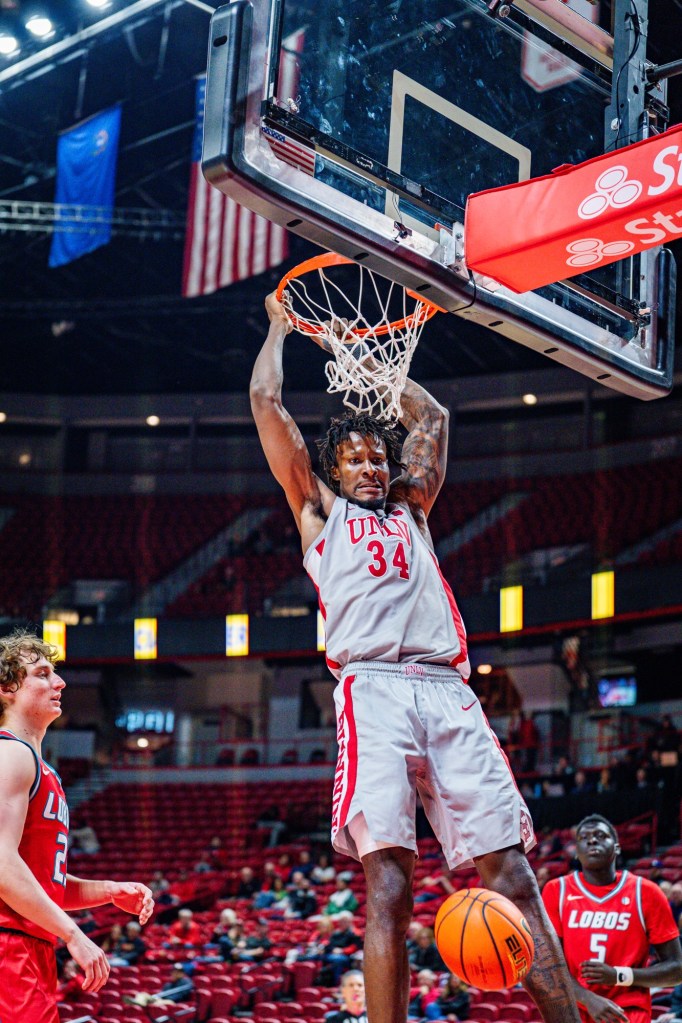
And yet, inside that inconsistency, something real developed. Dra Gibbs-Lawhorn became the offensive engine, finishing the season at 20.7 points per game while shooting 49.4 percent from the field, 57.1 percent on twos, and 40.8 percent from three. He was not just productive. He was essential. He gave this team a reliable source of offense, a player capable of creating something out of nothing when possessions broke down. Tyrin Jones emerged as a foundational piece, averaging 11.8 points, 5.1 rebounds, and 2.2 blocks while shooting nearly 60 percent from the field. His development gave the program a defensive anchor and a physical presence that had been missing. Kimani Hamilton added 12.9 points and 4.9 rebounds, providing versatility in the frontcourt, while Howie Fleming Jr. contributed 9.0 points, 6.3 rebounds, and 3.6 assists as a connective piece who helped stabilize lineups. Issac Williamson showed he can be a reliable scoring option at 8.6 points per game, and Jacob Bannarbie added 5.3 points and 4.6 rebounds, offering size and interior presence.
There are pieces here, but pieces only matter if they stay. The offseason is where this program will be defined. The Rebels are losing four seniors in Hamilton, Fleming, Al Green, and Walter Brown. That removes production, but more importantly, it removes structure, leadership, and continuity. Players who understood how to operate within the system are gone, and that creates a gap that cannot simply be filled with replacements.
The real pressure is on retention. Ladji Dembele and Myles Che are at the top of the list of players who must stay. Both were expected to be major contributors before injuries disrupted their seasons. Che, specifically, is the only true organizer on the roster. His return is not just important. It is structural. Without him, this team falls back into the same committee ball-handling that has defined too many possessions over too many seasons. Issac Williamson must stay. Mason must stay. Jacob Bannarbie must stay. That group forms the foundation.
Then there is the next tier. Naas Cunningham is the most obvious candidate to leave. He averaged 5.1 points on the season, but his role dropped to just over three points per game in conference play. He struggled defensively, fell out of favor, and the fit clearly weakened late. And then there is the reality this program cannot avoid. The players most likely to leave are also the players it can least afford to lose. Dra Gibbs-Lawhorn. Tyrin Jones. This is the modern game. Development creates exposure. Exposure creates value. And value creates movement. If both leave, this is not a retool. It is a reset. And that would put the program right back where it has been.
Emmanuel Stephen represents the uncertainty behind that reality. He averaged 3.3 points and 4.0 rebounds, showed flashes physically, but never developed consistency and fell out of favor. He remains a project, and in this era, projects rarely get time.
Which brings everything back to the portal. Keeping the core is only half the battle. Building around it is what determines whether this program continues to run in place or finally moves forward. The needs are clear. A starting wing shooter who can defend and shoot at a high level after the Rebels finished at 31.8 percent from three while allowing 34.5 percent. A veteran defensive guard who can stay in front of elite scorers and eliminate the need for constant help defense. A stretch four to replace Hamilton and maintain offensive balance. And if Gibbs-Lawhorn leaves, a true alpha, a high-major caliber lead guard who can control the offense and play 30-plus minutes immediately. Without that, nothing else works.
And none of it happens without investment. NIL is not secondary anymore. It is the foundation. Programs that invest retain. Programs that do not reset. This program is now at that line. Because the gap between 18-17 and relevance is not massive. It is precise. A few players. A few possessions. A few decisions made correctly in the offseason. But those decisions have to be right, and they have to be supported.
Because the Mountain West does not allow for error. One bid most years. Every loss matters. Every missed opportunity compounds. This team felt that this season, and it cannot afford to repeat it.
The season ended in Tulsa. The record sits at 18-17. On the surface, it looks like more of the same. But underneath, there is something different. There is a framework, a program that, for the first time in years, is not guessing at what it wants to be.
Now comes the part that determines whether it matters.
Because college basketball does not reward potential.
It exposes it.
And this program has spent long enough being exposed.