


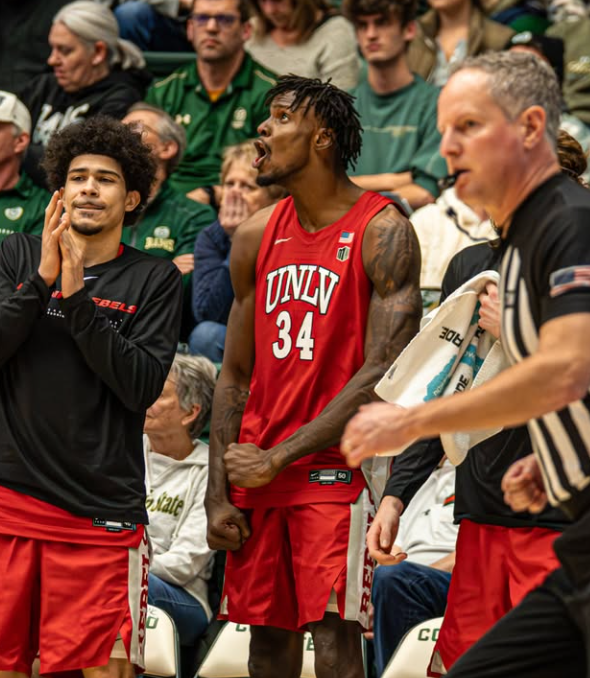
Las Vegas – The shot dropped in Boise. The building went quiet. And suddenly, UNLV felt different.
The Rebels return to the Thomas & Mack Center on Wednesday night riding a three-game win streak after an 86-83 overtime comeback at Boise State that may have changed the temperature of their season. Now comes the rematch with Colorado State, the team that handed UNLV a 70-62 loss in Fort Collins on Jan. 9.
That one still lingers.
“They beat us the first time we played,” head coach Josh Pastner said. “We came out down 9-0. We had some leads late. But we had 16 turnovers, and they had 12 offensive rebounds for 16 second-chance points. They out-toughed us.”
That was the early-season version of this team. The current one looks sharper. More defined. More connected. “We’ve settled into the rotation,” Pastner said. “The guys understand their roles. We’re just better. We’ve improved.”
And it all starts with Dravyn Gibbs-Lawhorn.
Eat. Sleep. Hoops.

In Boise, Gibbs-Lawhorn poured in a career-high 36 points. He scored 25 in the second half. Over the last three games, he has logged 124 minutes and 49 seconds. He has not blinked.
“When you have a coach that fully believes in you and lets you play without worrying about anything, it’s hard not to be successful,” Gibbs-Lawhorn said. “I work so hard. I feel like I deserve what’s happening because of everything I sacrificed.”
His routine is simple.
“I’m just staying in the gym. Eat, sleep, play basketball,” Gibbs-Lawhorn said. “There’s really nothing more to it.”
He even chose his living situation intentionally.
“I stayed 20 minutes off campus for a reason. I don’t want to be around the strip and distractions. That’s helped my routine.”
Pastner has praised the scoring surge, but he continues to demand more.
“He’s scored as well as anybody in the country right now,” Pastner said. “But his identity has to be tough. He’s got to defend without fouling.”
That accountability is part of the growth.
Winning is hard.
UNLV trailed Boise State by 23 in the first half. It looked finished. Instead, the Rebels clawed back.
Tyrin Jones flipped overtime with a put-back. Isaac Williamson buried a three. The Rebels closed.
“Winning is hard,” Pastner said. “If I could hug a win, I would. It’s such a fine line in sports.” The Rebels are learning to live on that line. “We’ve had some really good wins,” Pastner said. “We’ve had some tough losses. But you want to see your team improving. And we have.”
Now comes the next challenge.
Handling success.
The matchup: margin and the 3-point line.
Colorado State enters on its own three-game win streak. The Rams shoot it well. They space the floor. They punish teams from deep.
“We’re going to have to guard the three-point shot,” Pastner said. “We know that.”
The first meeting was decided by possessions: Turnovers. Offensive rebounds. Second chances. UNLV must flip that math. In conference play, the Rebels rank near the top of the Mountain West in effective field goal percentage and offensive rebounding. But defensively, they have been vulnerable from the three-point line against a balanced CSU perimeter attack that cannot be repeated.
“Rebounding is about effort,” Pastner said. “It’s a controllable. It’s a foot fight.”
UNLV has hovered in the mid-30 percent range on the offensive glass in recent games. That is winning territory in this league.
Extra shots create margin.
Margin wins close games.
Keys to the game
Guard the arc. No rhythm threes.
Colorado State thrives when the ball moves side to side, and shooters step into space cleanly. The Rebels must contest early and often.
Win the possession battle.
Sixteen turnovers and 12 offensive rebounds decided the first meeting. UNLV must stay under double-digit turnovers and attack the glass with discipline.
Handle the zone.
Colorado State shifted late in Fort Collins, and the Rebels stalled. The paint must be touched. The short corner must be occupied. The ball must move.
If it sticks, the game tightens. If it swings, clean looks follow.
Matchups to watch
Gibbs-Lawhorn vs. defensive attention

He is using nearly a quarter of UNLV’s possessions. He is efficient. He is fearless. He is in rhythm.
Does Colorado State trap him? Switch him? Sit in zone and force the ball out of his hands?
If he sees single coverage, he can flip the game quickly. If the Rams load up, others must convert.
Kimani Hamilton vs. foul trouble

This might be the hinge. Hamilton’s versatility allows UNLV to toggle lineups. He guards up. He can slide to the five. He rebounds outside his area. “Keeping our main guys in there defending without fouls is a big deal,” Pastner said. “It’s cost us games.” If Hamilton plays disciplined minutes, UNLV maintains flexibility. If he sits early, Colorado State gains comfort.
Tyrin Jones and the paint

Jones raises UNLV’s defensive ceiling. He protects the rim. He erases mistakes. If he stays on the floor, UNLV’s length disrupts spacing. If he sits, the Rams get cleaner airspace.
Conditioning and trust
Pastner shortened the rotation late at Boise. He trusted his core. “You can’t be a high-level athlete if you’re not in great physical condition,” Pastner said. “VO2 max shape. That’s a standard.” Gibbs-Lawhorn is playing major minutes. Jones is back. Roles are clearer. Execution matters now. “We had leads late the first time,” Pastner said. “We made turnovers.” If this rematch tightens in the final four minutes, it will not be emotion that decides it.
It will be discipline.
What it means
UNLV is 13-12 overall and 8-6 in Mountain West play with six regular-season games remaining.
Colorado State is more than a revenge opportunity.
It is positioning.
It is validation.
It is proof that the Boise comeback was growth, not adrenaline.
“We’re a team that can beat anybody,” Pastner said. “But if we don’t play with toughness and urgency, we could lose to anybody.”
The Rebels have shown they can survive chaos.
Wednesday is about something harder. Control.
Tip is set for 8 p.m.
Momentum is real.
Handling it is the next step.
Leave a Reply