



There isn’t much mystery left in UNLV’s season, only a shrinking margin for error.
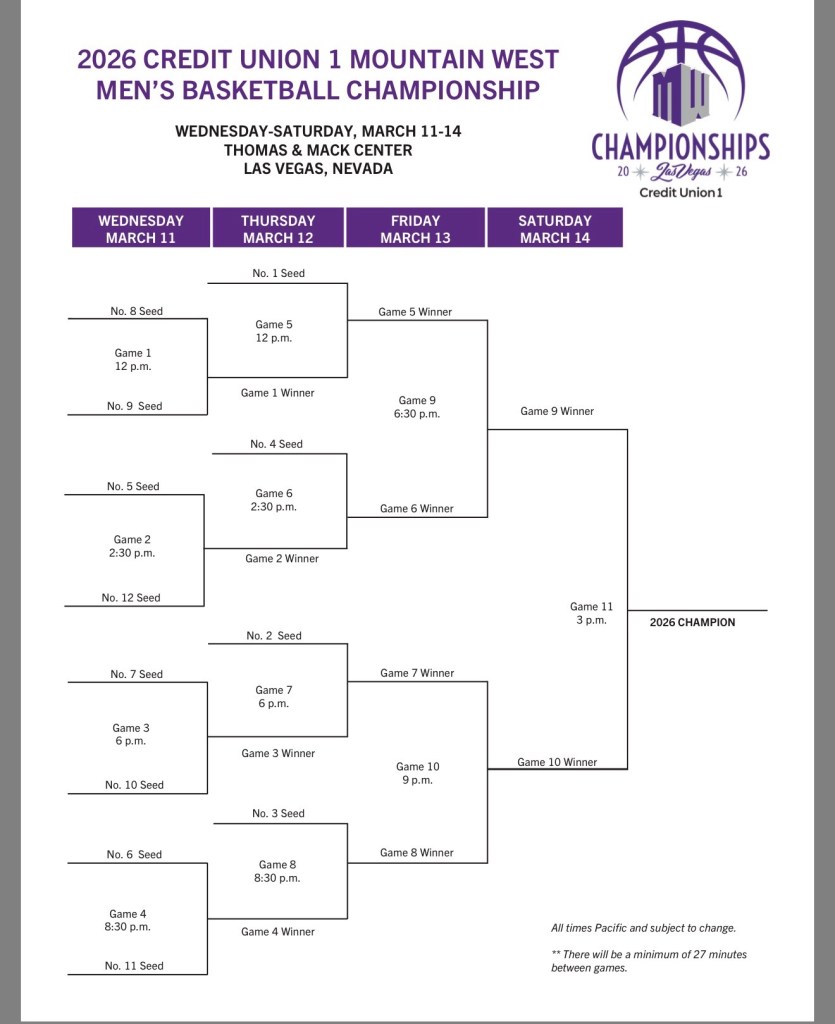
With five games remaining and the Rebels sitting at 8-7 in the Mountain West, the picture has sharpened. The at-large path never truly materialized. This has been a one-bid reality for UNLV all year. If the Rebels are going to the NCAA Tournament, it will be because they win three, or more likely four, games in four days in Las Vegas.
The conversation now shifts to where UNLV is most likely to finish and what that means for March.
The standings have created real separation at the top. Utah State, San Diego State, and New Mexico have built a cushion. Grand Canyon holds the final double-bye position at 10-5. UNLV sits two games back at 8-7 with five to play, close enough to see the line but far enough away that the margin for error is essentially gone.
If the tournament started today, the Rebels would open on Wednesday, and history says that matters.
For a decade, March in Las Vegas has followed the same script. UNLV gets into the bracket. UNLV handles the lower seed, often Air Force or whoever lands in that Wednesday window. Then the run stalls on Thursday. Since 2014, that has been the lived reality for Rebel fans. Different rosters. Different coaches. Same stopping point.
Until it changes, that quarterfinal ceiling remains the most honest measuring stick for this program.
The most realistic landing zone sits in the middle of the bracket. If UNLV handles the games, it should split the heavier swings, and the Rebels likely finish somewhere in the 5-7 range. That path means four wins in four days in Las Vegas, doable in theory but historically unforgiving in this league.
A 1-4 or 2-3 finish to close Mountain West play points UNLV toward the middle-lower bracket math. At 9-11 or 10-10 in league play, the Rebels are far more likely to land in the 7/8/9 range than creep into the 4/5 line. The six seed can remain in play depending on how the standings compress, but at this point, it profiles more as the ceiling than the expectation.
From here, the path is straightforward but not easy.
Air Force on the road is the one UNLV has to bank on. Reno at home is winnable but never clean. Rivalry games rarely are. Utah State comes into the Mack with revenge fully loaded after blowing that 14-point lead in Logan, and that one carries real seeding weight.
The two environments that will ultimately define the ceiling are Grand Canyon and San Diego State on the road.
Josh Pastner said it plainly after the Colorado State loss. For whatever reason, this group has shown better energy on the road. That is why those games are realistic. UNLV has already proven it can walk into hostile buildings and punch.
But realistic and likely are not the same thing.
Both buildings are among the toughest in the Mountain West, and both opponents are playing with real March urgency. Stealing one is possible. Expecting it is different math.
What keeps UNLV dangerous, and why no higher seed will be comfortable in Las Vegas, is the offensive ceiling. Dra Gibbs-Lawhorn has become a true late-clock problem. The Rebels can score in bursts. They have shown they can quickly erase deficits. They have also proven that the moment does not speed them up on the road.
The volatility still shows up on the other end.
Pastner did not hide from it. When you score 86, you are supposed to win. The issue has not been whether UNLV can generate offense. It is whether they can stack enough clean defensive possessions to stabilize games before they become rescue missions.
In a single-elimination setting, that volatility can survive for a night.
Over multiple days in March, it usually gets exposed.
UNLV can look like a bid stealer or be one-and-done on Wednesday. That is the roller coaster this team rides.
So what should Rebel fans realistically expect?
The cleanest read is this: UNLV is tracking toward the middle of the Mountain West bracket and a Wednesday start in Las Vegas. The double-bye push is still alive, but it requires near-perfect execution over the final stretch. If defensive lapses continue, the floor keeps pulling toward the crowded middle, where the path gets longer, and the margin gets thinner.
None of this removes the danger factor. This team is capable of making March uncomfortable for someone. They have already shown that in hostile environments.
But until UNLV proves it can string together disciplined defensive performances over multiple days and finally step past the quarterfinal wall that has held since 2014, expectations have to stay grounded in what the program has actually shown.
The opportunity is still there.
The margin just is not forgiving anymore.
Leave a Reply