
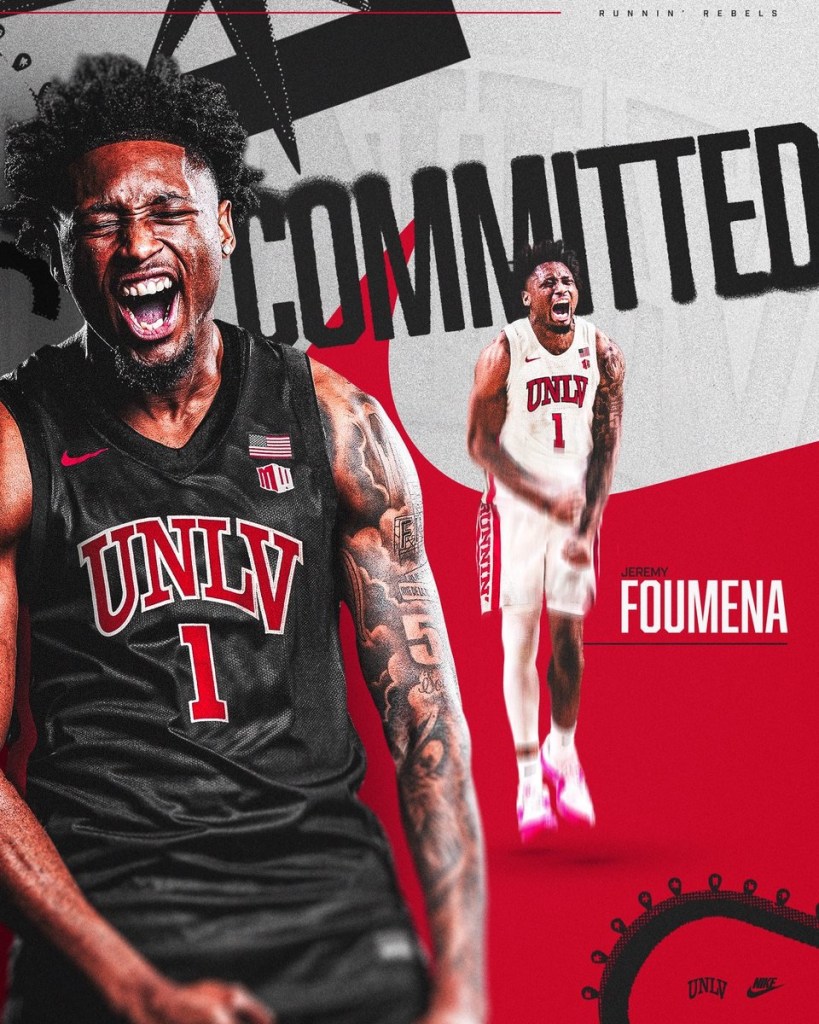
LAS VEGAS — UNLV’s addition of Jeremy Foumena is not about long-term upside. It is about role.
At this point, the evaluation is what it is. Foumena is a 6-foot-11, 250-pound center who plays through physicality, effort, and presence around the rim. He is not coming in to reinvent anything. He is coming in to do what he has done everywhere else.
Foumena appeared in 26 games for UCF during the 2025-26 season, averaging 3.5 points and 2.3 rebounds while shooting 54.8 percent from the field. The role was limited. His minutes came in short bursts, usually tied to energy and interior presence more than anything consistent within the rotation.
That pattern has followed him throughout his career.
He started at Rhode Island, where he redshirted before working his way into a bench role the following season. In 28 games, he averaged 5.3 points and 3.5 rebounds while shooting over 52 percent from the field. The production was efficient and didn’t require touches to be effective. There were flashes along the way, including a 16-point, seven-rebound game against Wagner, 14 and six against Fairfield, and a 12-point, 10-rebound double-double against New Hampshire. When he was active, it showed up.
He then transferred to Mississippi State, where the opportunity narrowed in a deeper rotation. Foumena appeared in nine games and averaged 1.1 points and 0.6 rebounds, with most of his minutes coming in non-conference play. He scored 10 total points on the season and was used situationally as a depth piece. The role did not change. The minutes did.
At UCF, it circled back to something familiar. Foumena settled into a rotational role, providing energy in short stretches without being part of anything long-term in the lineup. There were still moments, including an 18-point, seven-rebound performance against Quinnipiac and a 12-point, eight-rebound game against Cincinnati. Over the course of the season, though, the pattern didn’t really shift. Short runs, physical minutes, and limited offensive responsibility.
Across three stops, the role has been consistent. Foumena has been a rotational center, valued for size, effort, and physical play more than sustained production. That is the baseline.
His game reflects that.
Offensively, everything is around the rim. Putbacks, drop-offs, quick finishes. He runs the floor, finds position, and converts when the ball finds him. There is no spacing element here. No self-creation. That’s not his game, and it doesn’t need to be.
Defensively, it’s about presence. He can absorb contact, hold his ground, and give you physical minutes inside. He is not a primary rim protector, but he can make things tougher in the paint when he is engaged.
So the question is not what he is. That part is established. The question is how often you get it.
That’s where the UNLV fit comes in. The Rebels needed size. Needed someone who could actually play like a center for stretches. Last season made that pretty obvious. Foumena checks that box. He gives them a body they didn’t consistently have, and he does it without needing the offense to change.
Foumena likely projects as a rotational role rather than a major minutes jump. Foumena gives UNLV a situational interior presence, someone who can provide physical minutes, absorb contact, and stabilize lineups when needed. The question is whether that role expands or stays exactly what it has been.
Because that’s the reality of the move.
This is not something that changes the ceiling on its own. It is a depth addition with a purpose.
Foumena joins Cam Miles, MJ Thomas, Terrance Ford, and Tyler Harris in a transfer class that continues to take shape, alongside the return of Tyrin Jones and Issac Williamson. The direction is clear. UNLV is prioritizing size, physicality, and defined roles across the roster.
Foumena fits that direction. Now it comes down to whether the role holds. Foumena has been the same player at every stop. If he rebounds, defends, and provides consistent physical minutes, he will have value.
If not, this addition will not change much.