

LAS VEGAS — The next stop in our UNLV football position preview series is the wide receiver room, one of the biggest transition spots on the 2026 roster.
The Rebels are not replacing one productive player. They are replacing the structure of an entire room. Jaden Bradley was the headliner, but the departures of Troy Omeire, DaeDae Reynolds and JoJo Earle make this a broader rebuild. Together, that group gave UNLV size, explosives, reliability and movement within the offense.
That is what makes this room so important. Last season, Bradley, Omeire, Reynolds and Earle combined for 144 catches, 2,174 yards and 14 touchdowns. Put another way, UNLV is replacing 61.9% of its receiving yards and 58.3% of its receiving touchdowns.

This preview is not just about finding a new No. 1 receiver. It is about whether Taeshaun Lyons, DeAngelo Irvin Jr., Taz Reddicks, Troy Stellato, Amorion Walker, Kayden McGee and the younger receivers can collectively give Dan Mullen enough answers to keep the offense balanced, explosive and flexible around either Jackson Arnold or Alex Orji.
The running backs may give UNLV its offensive floor. The tight ends may define its flexibility. The offensive line may decide whether everything works. But the wide receivers may determine how dangerous the offense can actually become.
Bradley led last year’s receiver room with 58 catches for 931 yards and four touchdowns. Omeire gave the Rebels 31 catches for 514 yards and five touchdowns. Reynolds added 33 catches for 471 yards and five scores. Earle caught 22 passes for 258 yards and gave the offense another movement piece.
That is why this is not a normal receiver-room transition. UNLV is trying to replace volume, explosive plays, size, red-zone production and week-to-week structure at the same time.
The reason is simple: Mullen’s offense is built on stress, and the receivers have to finish that stress. The quarterback run game can hold linebackers. The running backs can keep the offense on schedule. Tempo and formations can force communication. But if receivers cannot win outside, defenses can load the middle. If they cannot separate underneath, quarterbacks have to hold the ball. If they cannot threaten vertically, safeties can get aggressive. If they cannot block, the perimeter run game loses some of its bite.
That is the lens for 2026. UNLV has returning experience in Lyons, Irvin and McGee. It added transfer production in Reddicks. It added Power Four experience in Stellato and Walker. It has young developmental pieces behind them. The room has options. Now those options have to become roles.
Lyons is the returning receiver who can change the shape of a defense.
He caught 16 passes for 241 yards and three touchdowns last season, averaging 15.1 yards per catch. Those are not No. 1 receiver numbers, but they show a player who made his touches count. He did not need eight targets a game to affect coverage.
Lyons’ 72-yard touchdown against Hawaii was the kind of play that changes how a defense has to align. His 39-yard touchdown against Colorado State did the same thing. A receiver who can win downfield forces safeties to stay honest. That creates lighter boxes for the run game, more room for option looks and more space for underneath routes.
That is why Lyons’ role is bigger than his target total. He has the best returning explosive profile in the room. He is 6-foot-1 and 180 pounds, which gives him enough size to play outside without being limited to gadget work. He went to Washington, spent time at Utah and now has a year in UNLV’s program. The talent has never been the question. The next step is whether he can become dependable enough to carry a larger role.
Lyons does not have to become Bradley. He has to become the receiver who changes the math. His job is not just catching deep balls. It is making defenses feel the threat of them.

Reddicks gives UNLV the clearest incoming production profile.
He comes from Oregon State after catching 30 passes for 391 yards last season, playing in 10 games and making three starts. His 11-catch, 158-yard game against Fresno State showed he can handle real volume, which matters in a room trying to replace so many weekly targets.
Reddicks gives UNLV something it needed: a receiver who has already been part of a college passing game and can be asked to do more than run clear-out routes. At 5-foot-11 and 195 pounds, his fit is less about pure height and more about functional strength, route reliability and yards after the catch. Some throws in Mullen’s offense are quick hitters, bubbles, screens, crossers and sit routes that ask a receiver to catch the ball in traffic and turn five yards into nine.
That is where Reddicks can help. He can be a possession-plus receiver. Not just a possession receiver in the boring sense, but a player who can work the middle of the field, handle contact, win against nickel defenders and give the quarterback an answer when the defense is trying to take away explosives. If Lyons stretches the defense vertically, Reddicks can help keep the offense ahead of schedule.
The football implication is obvious. UNLV lost more than Bradley’s numbers. It lost the weekly structure of a receiver room that had several places to go with the ball. Reddicks may be the closest thing in the room to a ready-made replacement for that kind of function. He should not have to replace last year’s production by himself, but he probably has to become one of the most trusted receivers quickly.

Stellato gives the room a veteran route-running piece.
He comes to UNLV after stops at Clemson and Kentucky, with 65 career catches for 600 yards and two touchdowns at Clemson. His best season came in 2023, when he caught 38 passes for 321 yards and a touchdown, then followed with 25 catches for 264 yards and a score in 2024.
That kind of experience matters because receiver play in Mullen’s offense cannot be only about speed. Receivers have to understand coverage. They have to know when to throttle down, when to keep running, when to expect the ball and how to adjust when a quarterback extends the play. Stellato’s value is likely in route detail, timing and feel.
That is not a small role. Every offense needs a receiver who understands how to win without needing the ball schemed to him. Stellato does not need to be treated like a savior. He needs to be treated like a veteran who has played in real games, caught passes in real systems and can help a quarterback avoid bad downs. If he becomes a reliable third-down receiver or inside-outside piece, the room changes because the Rebels would not be dependent only on Lyons’ explosives or Reddicks’ transition.
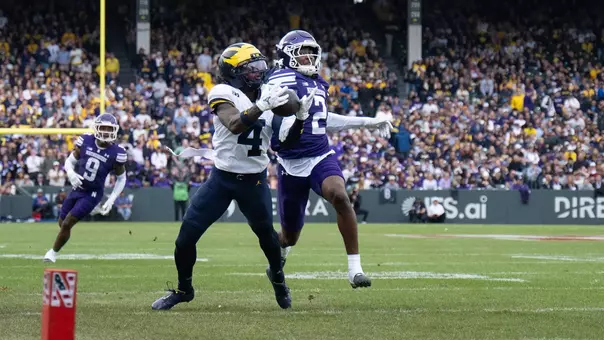
Walker is the size bet.
At 6-foot-4 and 180 pounds, he brings the kind of frame UNLV does not have much of at the top of the room. He spent time at Michigan, played on both sides of the ball and was part of a national championship program before transferring to Middle Tennessee State. Last season, he played in 10 games, made five starts and caught 15 passes for 201 yards and a touchdown.
The production is not overwhelming, but the fit is obvious. Walker gives UNLV length. He gives the Rebels a bigger target. He gives Mullen a player who can affect the red zone, back-shoulder throws, fades and contested catches if he develops consistency. He also gives the offense a receiver who can make the quarterback look right even when the throw is not perfect.
Walker’s challenge is refinement. Can he separate consistently, finish through contact and become reliable enough for his size to matter every week? Bradley and Omeire gave last year’s receiver room real size and catch-radius value. Walker is the most obvious veteran candidate to help replace that physical dimension.
Irvin gives UNLV movement, experience and a role that should translate.
He is not built like Bradley, Omeire or Walker. He is 5-foot-8 and 170 pounds, and his value comes from movement, versatility and experience. Last season, he appeared in all 14 games, started four, caught 18 passes for 188 yards and a touchdown, returned punts and added a small rushing role. He also had a 60-yard grab-and-run against Boise State, which showed the kind of space-player value he can bring.
Irvin can be the motion piece. He can be the quick-game outlet. He can be used on screens, swing passes, jet-action looks and underneath routes that make the defense tackle in space. In a Mullen offense, that kind of player has value because the offense wants to create conflict. If a linebacker is stepping toward the run, Irvin can be the receiver catching the ball behind him. If a nickel defender is worried about motion, Irvin can force communication before the snap.
His special teams value also matters. Irvin has returned punts, played multiple offensive roles and stayed on the field across different versions of UNLV’s offense. That makes him more than depth. It makes him a trust player. His ceiling may not be as high as some of the bigger receivers in the room, but his floor matters. Not every receiver has to be the star. Some have to keep the offense functional.
McGee gives UNLV another way to create explosives without needing traditional receiver volume.
His nickname is “Big Play,” and his UNLV résumé explains why. In 2024, he caught three passes for 97 yards and a touchdown, averaging 32.3 yards per catch. In 2025, he appeared in 12 games, rushed for 56 yards and a touchdown on seven carries, blocked a punt and returned another blocked punt for a touchdown against Wyoming.
McGee may not fit a traditional receiver profile, but he fits winning football. He has already shown special teams value, gadget value and explosive value. He may not open the season as one of the first receivers in the rotation, but he has real paths to playing time because he can affect field position and stress a defense horizontally. A spread-to-run offense needs perimeter players who make defensive backs tackle and linebackers run.
The rebuilt receiver room also does not have to carry the entire passing game alone. Jai’Den Thomas caught 39 passes for 237 yards last season, and the tight ends give Mullen other ways to create answers underneath. But if the receivers cannot threaten defenses outside and downfield, those complementary pieces become easier to crowd.
The young receivers matter, but the 2026 season will be decided by the top of the room.

Bell and McNair headline the developmental group. Bell arrived as a unanimous three-star receiver after catching 167 passes for 2,200 yards and 25 touchdowns at Heritage High School in Texas, while McNair originally signed with Utah and gives UNLV another longer young receiver with a real recruiting profile. Carner and Miles give the room future size, while Boden, Zachary and Titone-Perez add depth.
Not every young receiver has to become part of the weekly rotation in 2026, but UNLV needs enough development behind the veterans to avoid rebuilding the room again next offseason.
Still, the immediate issue is the top group. UNLV does not need every receiver to break out. It needs the right receivers to define the rotation early. Lyons has to become more than an occasional explosive. Reddicks has to translate Oregon State production into a central role. Stellato has to turn Power Four experience into trust. Walker has to make his size matter. Irvin has to keep giving the offense movement and reliability. McGee has to turn special teams and gadget value into a larger offensive argument.
That is why this group is so important to the quarterback conversation.
UNLV’s quarterback job is expected to come down to Arnold or Orji, and each one would ask something different from the receiver room. Arnold needs timing, separation and receivers who can be where the concept expects them to be. Orji needs blocking, explosives and efficient answers when defenses load the box to take away his rushing value.
The receiver room has to make both versions of the offense playable. With Arnold, the passing game can be more complete if the receivers separate on time. With Orji, the passing game may not need 40 attempts to win, but it has to punish defenses that overplay the run. That is the real fit question. Can this room help Mullen call the whole offense, regardless of which quarterback wins the job?
That is what last year’s receiver room helped UNLV do. Bradley, Omeire, Reynolds and Earle were not the same player, and that was the point. They gave the Rebels different answers. They gave UNLV size, explosives, underneath production and movement. The 2026 room has to give Mullen that same kind of variety, but with a mostly rebuilt group.
UNLV has built the room like a program that understands what it lost. The Rebels did not simply hope Lyons and Irvin would make up the difference. They brought in Reddicks, Stellato and Walker. They added Bell and other young receivers. They created competition. Now fall camp becomes about sorting roles instead of searching for bodies.
That is the challenge: turning names into a rotation. Lyons brings vertical stress. Reddicks brings production and chain-moving potential. Stellato brings route detail and Power Four experience. Walker brings size. Irvin brings movement and reliability. McGee brings special teams and package value. Bell, McNair, Carner, Miles, Boden, Zachary and Titone-Perez give the room developmental depth.
On paper, that gives UNLV enough variety to rebuild the passing game. Now it has to become dependable.
If the room settles quickly, Mullen can stretch the field, protect Arnold or Orji, punish loaded boxes and keep the offense from becoming too tied to the run game. If it does not, the quarterback battle gets harder, the run game sees more bodies and the offense loses some of the stress that makes Mullen’s system work.
UNLV does not need one receiver to become Jaden Bradley. It needs a room good enough that defenses cannot treat his absence like an answer.