
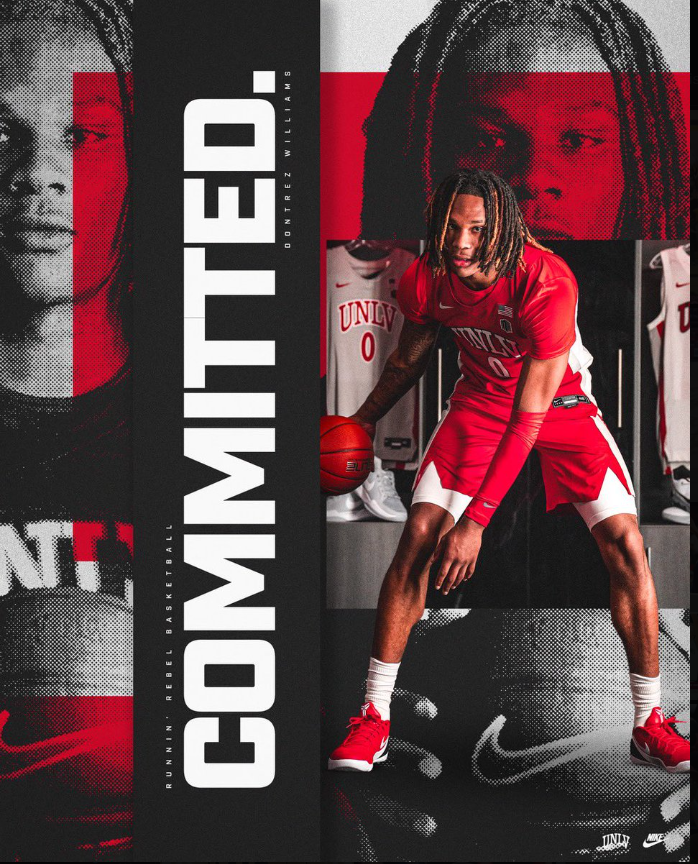
LAS VEGAS — UNLV has landed small forward Dontrez Williams in the transfer portal from Lindenwood.
Landing Williams, along with players like MJ Thomas, is a clear signal from Josh Pastner’s program about the direction this team is heading. As Pastner continues to reshape the Runnin’ Rebels, the mission has become clear. The Rebels aren’t just trying to win games. Pastner is trying to establish an identity and culture built on defense, grit and toughness. After a season that exposed inconsistencies on that end of the floor, his response has been clear. The 2026-27 roster is being built around players who can sustain pressure, disrupt rhythm and compete on every possession.
Williams fits that vision immediately.
The 6-foot-5 guard arrives in Las Vegas as a clear piece that Pastner can build his culture around. He is a tone-setter. His game reflects the traits Pastner has emphasized throughout what he has called a “full program rebuild.” Length, activity and a relentless motor define how he plays, and those qualities show up well beyond traditional box score numbers.
Williams is coming off a breakout sophomore season at Lindenwood, where he averaged 15.2 points, 5.1 rebounds and 2.1 assists per game. While those numbers point to a player capable of handling offensive responsibility, his impact is best understood on the defensive end.
He averaged 2.59 steals per game, ranking among the national leaders, and set a Lindenwood Division I era record with 75 total steals. That level of production reflects more than effort. It shows anticipation, discipline and the ability to consistently disrupt opposing offenses.
Williams creates problems for opponents. He gets into passing lanes, pressures ball handlers and turns mistakes into immediate scoring opportunities. A single deflection can become a steal, and a single steal can shift momentum and wake up what can be a dormant Thomas and Mack Center.
Williams began his career at Abilene Christian, where he averaged 5.8 points per game as a freshman and earned WAC All-Freshman Team honors. He was not a primary option, but he found ways to contribute through defense, rebounding and effort. His impact on the game may not have always shown in the box score, but it always showed on film.
At Lindenwood, the game really opened up for him. The role got bigger. Minutes got higher. He became someone the offense could run through at times, but what stood out was that his defensive effort never dropped. That part of his game always stayed constant. The jump from a rotation piece to a player teams had to plan for says a lot about how he is wired.
That ability to adapt is a big reason he fits at UNLV.
Williams brings a defense-first mentality. He is long, quick and understands where he is supposed to be. He can stay in front of smaller guards and hold his own when switched onto bigger wings. That kind of versatility matters. It gives UNLV options defensively and allows them to be more aggressive without constantly worrying about matchups.
That play style also allows Pastner to implement what he wants.
The approach is straightforward. Speed teams up. Force mistakes. Win extra possessions. Williams fits that system without needing the ball, which gives him a clear path to early minutes.
Defense travels. Effort travels.
Offensively, the evaluation becomes more complex.
Williams was at his best at Lindenwood when the game opened up. He attacked space, got downhill and played effectively in transition. His scoring came from movement, timing and taking advantage of defensive breakdowns rather than isolation or high-volume shot creation.
That changes in the Mountain West.
The conference is more physical and more structured. Possessions slow down, especially late in the clock. Transition opportunities are harder to come by.
At Lindenwood, he had the freedom to play through mistakes and find a rhythm with the ball in his hands. That changes at UNLV. The role will be more defined. Fewer touches. Faster decisions. Less room for error.
That shift puts the focus on one area. Shooting.
Williams shot 29.3 percent from three (27-of-92) and 56.3 percent from the free-throw line last season. If he can consistently knock down open perimeter shots, everything opens up. Including his chance to crack the rotation and become a big piece. Defenders will have to respect him, which creates driving lanes and improves spacing for Pastner’s offense. It also makes it easier to keep him on the floor in late-game situations.
If the shot remains inconsistent, defenses will adjust. They will sag off, clog the lane and force him into tougher decisions that could reduce his role to just a rotational piece. That will also limit his offensive impact and could affect his minutes depending on the matchup.
UNLV is not asking Williams to be a primary scorer. The expectation is that he plays within the structure of the offense and takes advantage of what is there. His defense should lock him into the rotation. What he becomes offensively will determine how big that role gets.
From a roster standpoint, the fit is clear.
Williams adds size and versatility to the backcourt, something Josh Pastner has prioritized. He can play alongside smaller guards or be part of bigger, defense-heavy lineups that emphasize switching and pressure. His ability to guard multiple positions gives UNLV flexibility it did not consistently have last season.
He also brings real production. Averaging over 15 points per game shows he can handle responsibility when needed. The challenge now is translating that into a more efficient role at a higher level.
Williams projects as a rotational piece with upside. If the defense carries over, which it should, he brings immediate value. That is his floor. If the shooting improves and the offense adjusts, that is where things change.
He joins a transfer class that includes Cam Miles, Terrance Ford Jr., Tyler Harris, MJ Thomas and Jeremy Foumena as UNLV continues its rebuild. The direction is clear. Add length. Add versatility. Add players who impact games in multiple ways. Williams fits that mold. He does not need the ball to matter. For a program trying to build a new identity and culture, that might be exactly what UNLV needs.