
LAS VEGAS — The next stop in our UNLV football position preview series is the running back room, the group that may give Dan Mullen’s offense its floor in 2026.
The quarterback battle will get more attention. The rebuilt receiver room may decide how dangerous the offense can become. The tight ends may determine how flexible Mullen can be. The offensive line may decide whether everything works. But the running backs give UNLV the most proven offensive piece on the roster.
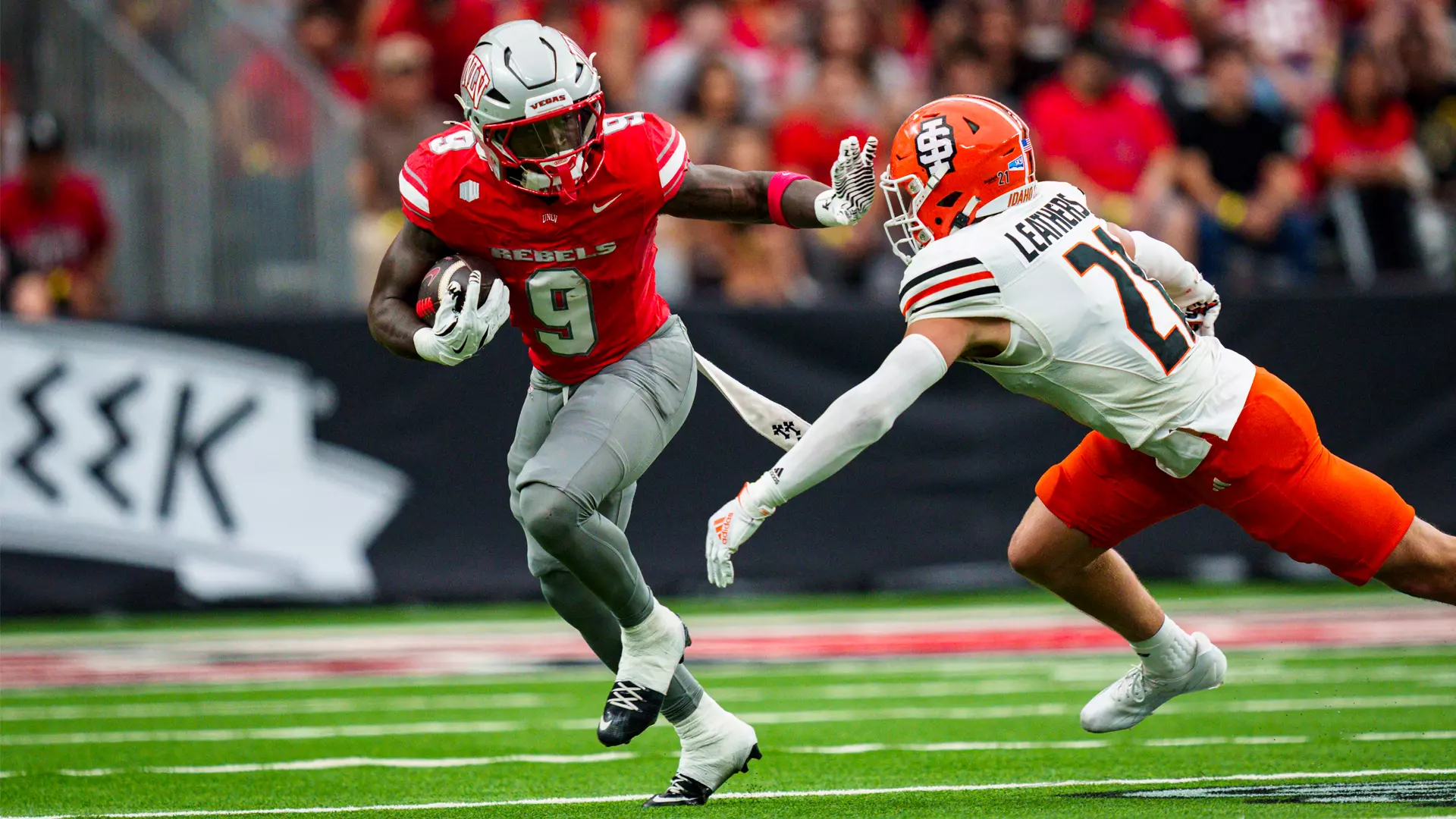
That starts with Jai’Den Thomas. He has earned that. He is the proven back, the most productive runner on the roster and one of the best offensive players in the Mountain West. But the deeper story is not only whether Thomas can build on a 1,000-yard season. It is whether UNLV has enough different answers behind him to make the offense harder to defend, less predictable and less dependent on whoever wins the quarterback job.
This preview is not just about Thomas. It is about whether Thomas, Jaylon Glover, Kamran Williams, Skylar Vann, Darrien Jones and Mohammad Maali can give Mullen a dependable rotation after losing Keyvone Lee’s production from last season.
Thomas gives the Rebels the headline. The rest of the room may determine how sturdy the offense becomes behind him.
The production backs that up. UNLV ran for 2,737 yards, averaged 5.5 yards per carry and scored 33 rushing touchdowns last season. Thomas was the headliner, but the room mattered. Lee rushed for 438 yards and six touchdowns, while Glover added 384 yards and averaged 6.0 yards per carry. That production behind Thomas helped keep the Rebels from becoming a one-back offense.
The quarterback piece matters, too. Anthony Colandrea rushed for 649 yards and 10 touchdowns last season, giving UNLV another major run-game stress point. That is gone now. Jackson Arnold and Alex Orji can both move, but the structure may change depending on who wins the job. That makes the running backs even more important. They have to give the offense a steady foundation while the quarterback role takes shape.
That matters because Mullen’s offense has never been just about handing the ball to a back and hoping he wins. The run game is tied to the quarterback. It is tied to spacing, tempo, option looks, formations and forcing defenses to account for more than one threat. At his best, Mullen uses the run game to make defenses hesitate before the ball is even handed off.
The running back has to fit that. He has to read it quickly, press the right gap, catch the ball when needed and block well enough to stay on the field.
That is why Mullen’s comments about the room last year mattered. He called it “one of the better rooms I’ve had all-time,” and the reason was not just talent. It was the mix. Mullen liked the depth, the different styles and the fact that the backs were not clones of each other. In his offense, that matters because one run concept can look different depending on who is carrying it.
That is the lens for 2026. UNLV has a lead back in Thomas. It has an experienced second option in Glover. It has younger developmental pieces in Williams and Vann. It has bigger-bodied depth in Jones and Maali. Lee’s production from last season has to be replaced, but the room still has enough bodies and enough skill variation to give Mullen choices. The question is whether those choices turn into a dependable rotation or stay as depth-chart possibilities.

Thomas gives UNLV the easiest answer.
He rushed for 1,036 yards and 12 touchdowns on 148 carries last season, averaging 7.0 yards per rush. He also caught 39 passes for 237 yards and a touchdown. Those numbers are not empty volume. They show a back who can create explosive plays, handle scoring opportunities and stay involved when the ball is not simply being handed to him.
Thomas’ receiving value matters almost as much as his rushing production. He caught 39 passes last season, giving UNLV a built-in outlet when defenses forced the ball underneath. In a year with a quarterback competition and a rebuilt receiver room, that matters. A back who can run for explosives, catch easy throws and stay on the field in protection can stabilize an offense while the rest of the passing game settles.
Thomas also has a history of producing before 2025. In 2024, he ran for 918 yards and seven touchdowns while averaging 5.6 yards per carry. As a freshman in 2023, he scored a school-record 12 rushing touchdowns for a freshman and finished second on the team with 503 rushing yards. That is three years of evidence, not one hot season. Thomas has been productive under different circumstances, with different quarterbacks and different versions of UNLV’s offense. He is not fighting to prove he belongs. He is fighting to prove he can be the best back in the conference.
The way he runs fits what Mullen wants. He can press a hole, make one cut and get vertical. He is not the biggest back in the room, but he is tough enough inside and dangerous enough in space that defenses cannot treat him as a situational player. Running backs coach Quinton Ganther called him a “slasher” and pointed to his toughness, resilience and preparation. That evaluation matches the production. Thomas is not just a fast back. He is a back who understands how to make his style work between the tackles.
That matters because the offense around him is changing. Colandrea’s departure removes a major rushing piece from last year’s offense. If Arnold wins the quarterback job, UNLV still has a mobile quarterback, but the offense may not look exactly the same. If Orji wins it or has a major package, the quarterback run game becomes more physical. Either way, Thomas has to be the constant.
He can keep the offense on schedule while the quarterback position gets sorted out. He can take pressure off Arnold if Arnold is trying to settle in at another stop. He can make Orji’s run packages more dangerous because defenses cannot only key on the quarterback. He can help any quarterback because backs who can run, catch and protect make life easier.
But Thomas cannot be the entire room.

That is where Glover matters.
His 2025 season did not match Thomas’ workload, but it showed why UNLV wanted him. He ran for 384 yards and a touchdown on 64 carries, averaging 6.0 yards per carry. He also caught six passes for 51 yards and returned 16 kickoffs for 312 yards. Before arriving in Las Vegas, he spent three seasons at Utah and totaled 982 rushing yards and six touchdowns on 227 carries.
That profile gives UNLV something valuable: a back who has played real college football, handled Power Four physicality and shown enough explosiveness to be more than a spare piece.
Glover is 5-foot-9 and 205 pounds, which gives him a different build than Thomas. He is compact, strong and capable of running through contact, but he also has enough burst to create when the lane is there. His 6.0 yards per carry last season matters because it came in a secondary role. Not every back stays efficient when touches are inconsistent. Some need rhythm. Glover gave UNLV useful snaps without needing the offense built around him. That is exactly what a No. 2 back has to do.
Glover’s role could grow in 2026 because Lee is no longer listed on the roster after rushing for 438 yards and six touchdowns last season. Those carries have to go somewhere. Thomas should get the first chance at the largest share, but Mullen has never sounded like a coach who wants one back taking every meaningful snap. He values different styles, and Glover gives him a credible second option with enough experience to keep the offense from dipping when Thomas comes off the field.
That is the difference between having a star and having a room. A star gives the offense an identity. A room gives the offense answers when the game changes. If Thomas is banged up, Glover can take real carries. If UNLV wants a slightly bigger back in a certain personnel group, Glover can do that. If special teams need field-position help, Glover has return value. If the game turns physical late, he has the frame to handle contact.
Replacing Lee is the biggest issue in the room.
Lee was not always the headline, but 100 carries, 438 yards and six touchdowns is real production. He gave UNLV size, reliability and another back who could finish drives. Without him, Glover has to absorb more responsibility, and at least one of Williams, Vann, Jones or Maali has to move closer to the rotation.
The top of the room is strong enough that UNLV does not need to panic. Thomas and Glover are a legitimate one-two punch. Thomas gives the Rebels the explosive lead back. Glover gives them experience, efficiency and a different body type. The concern is not the first two names. The concern is what happens after them.
The next layer is less proven, but it matters because running back depth usually gets tested.
The future of the room may ultimately come from Williams and Vann. Williams rushed for 6,250 yards and 63 touchdowns in four years at Jefferson High School in Texas, giving him a production profile that is hard to ignore even if his college sample is almost nonexistent. He appeared in one game against Hawaii last season and had one carry for one yard. That makes 2026 important for him.

Williams does not need to become a 15-touch player immediately. In a room with Thomas and Glover ahead of him, his first path is probably special teams, practice trust and lower-leverage offensive snaps. But with Thomas and Glover both seniors, UNLV needs to find out whether Williams can become more than emergency depth.
Vann gives the room another long-term option with a different skill set. He arrives from Western High School in Los Angeles as a unanimous three-star running back. As a senior, he rushed for 955 yards and four touchdowns on 117 carries, averaging 8.2 yards per attempt. He also caught 35 passes for 484 yards and two touchdowns, finishing with 1,439 all-purpose yards. The receiving production is the part that stands out.
UNLV does not need Vann to play right away, but his profile fits where college football is going. Backs who can catch the ball are not luxuries anymore. They are part of how offenses create matchups. A running back who can motion out, run option routes, catch screens and punish linebackers in space gives Mullen more flexibility. Vann may need time physically, but the skill set is worth developing.
That matters because the top of the room is experienced, but not young. Thomas is a senior. Glover is a senior. Maali is a senior. The room has production now, but the future has to be built before it is needed. Williams and Vann are not just depth pieces. They are the players who could help decide what this room looks like after the current veterans are gone.
Jones and Maali give UNLV bigger bodies behind the top rotation.

Jones is listed at 6-foot and 215 pounds and appeared in two games last season, rushing twice for nine yards. Maali is listed at 5-foot-11 and 210 pounds and brings junior college experience from Pasadena City College. Neither enters 2026 as an obvious feature back, but both give UNLV size to evaluate in camp, short-yardage options, protection depth and special teams possibilities.
Not every back in a room becomes a weekly offensive feature. Teams that want to play 13 or 14 games still need bodies who can handle the work when injuries arrive. Mullen said it himself last year. Players get nicked up during the season, and having several backs he feels comfortable putting into a game is a major plus. That is not coach-speak. It is roster reality.
Running back is a position where depth disappears quickly. One injury changes a rotation. Two injuries can change an offense. UNLV saw last season how valuable it was to have multiple backs capable of producing. Thomas was the star, but Lee and Glover combined for 822 rushing yards and seven touchdowns. That production behind the lead back helped keep the offense from becoming too one-dimensional.
That is where trust becomes the real story. Mullen has options. Ganther has talent to work with. The production at the top is real, and the depth is there on paper. But the best version of this room will not be built on names alone. It will be built on roles.
Thomas is the star. Glover is the proven complement. Williams and Vann represent the future. Jones and Maali provide size and depth. On paper, that gives UNLV one of the deeper running back rooms in the Mountain West. Now it has to become a dependable one.
The quarterback room will get most of the attention entering 2026. That is understandable. But if UNLV’s offense is going to survive the early part of the schedule and give Mullen the flexibility he wants, the running backs may be the group that gives the Rebels their floor.