UNLV athletics talks a lot about what it wants to become. It wants programs that win consistently. It wants coaches who understand Las Vegas. It wants teams that can recruit, develop and retain talent. It wants the city to care. It wants national credibility without losing local identity. It wants stability in an era where college sports rarely gives anyone time to build.
Lindy La Rocque is already doing all of that.
That is why her story should not be viewed as just another successful coaching run inside the athletic department. It is bigger than that. La Rocque has become the clearest example of what UNLV keeps trying to build across campus: a program with roots, standards, identity and results. She is not the promise of what UNLV athletics could be. She is the proof.
That matters because UNLV has spent years selling potential. The school has the market. It has the city. It has the growing sports landscape around it. It has the argument that Las Vegas should be a major advantage. But potential only matters when someone turns it into something people can see.
La Rocque has done that with women’s basketball.
Since taking over in 2020, she has gone 149-41 overall and 94-16 in Mountain West play. From 2021-22 through 2024-25, UNLV won at least 26 games in four straight seasons, finished first in the Mountain West four straight times and reached three NCAA Tournaments. Even a 21-11 season now feels like a step back because La Rocque changed the standard.
That is the point. A 21-win season feeling underwhelming is not failure. It is evidence of a program that has been rebuilt properly. Before La Rocque, UNLV women’s basketball was trying to become consistently relevant again. Now the question is not whether the Lady Rebels can win the Mountain West. The question is whether they can turn conference dominance into March credibility.
That is a different conversation entirely. Good coaches win games. Program builders change the way success is measured. La Rocque has changed the measurement.
That is what should make every other UNLV program pay attention. This is not about women’s basketball existing in its own lane. This is about one program on campus showing what happens when the right coach, the right place and the right plan line up.
UNLV football is trying to become more than a good story under Dan Mullen. UNLV men’s basketball is trying to matter again under Josh Pastner. UNLV baseball just hired Nick Garritano in part because of his connection to the local baseball ecosystem. Across the department, the same question keeps showing up in different forms.
How does UNLV turn Las Vegas into an actual advantage?
La Rocque has answered it better than anyone.
She did not make Las Vegas her entire pitch. That would be too small. She used Las Vegas as part of a larger identity. She was born and raised here. She went to Durango High School. Her family is here. Her parents are here. Her young children are growing up here. Her father, Al La Rocque, is a respected coaching figure in the city. Those roots matter, but they only matter because they are attached to winning.
That is where people sometimes get the La Rocque story wrong. This is not simply about a hometown coach staying home. That version is too sentimental. La Rocque is not successful because she is local. She is successful because she paired local understanding with national standards.

She played at Stanford under Tara VanDerveer, reached four Final Fours as a player and later returned to Stanford as part of the coaching staff. She also spent time at Oklahoma under Sherri Coale. That background matters because La Rocque did not come back to Las Vegas with a small vision for what UNLV could be. She came back with a clear understanding of what elite programs look like, how they operate and how they hold people accountable.
That is the difference between being local and being limited. La Rocque is local. Her program is not limited.
That is the standard UNLV should be chasing.
The Lady Rebels have an identity people can explain. They are organized. They are development-driven. They value practice structure. They recruit high school players with the intention of growing them. They use the transfer portal, but they do not want the portal to become the entire foundation of the program. They are trying to build something that survives roster movement instead of being controlled by it.
That matters now more than ever because college athletics is built on instability. The transfer portal changes rosters every spring. NIL changes leverage. Coaches move. Players move. Programs are constantly trying to figure out whether to build for the future or chase the fastest possible fix.
La Rocque’s program has not ignored the modern game. It has adapted without losing itself. That might be the most important lesson.
What La Rocque is testing is not unique to Las Vegas. Across college athletics, programs outside the power conferences are trying to answer the same question: can you still build a sustainable winner in an era defined by transfers, NIL money and constant roster turnover? Some programs chase portal classes every offseason. Others lean heavily on NIL collectives. Some try to survive year-to-year with short-term fixes because that is what the modern calendar almost forces them to do.
La Rocque has largely bet on something different.
Development. Retention. Identity.
That approach feels increasingly uncommon, which is exactly why it deserves attention beyond the Mountain West. UNLV women’s basketball is not the biggest brand in the sport. It does not have the resources of the SEC, Big Ten or ACC. It is not operating with the same margin for error as the programs that can miss on one class and reload the next spring. That is what makes the Lady Rebels interesting. They have had to build something more intentional.
That is where La Rocque has separated herself. She has not treated continuity like an old-school talking point. She has treated it like a competitive advantage. In a sport where rosters can change overnight, keeping a program’s identity intact might be just as valuable as landing the next transfer.
UNLV does not need every coach to build exactly like La Rocque. Different sports require different models. Football is not women’s basketball. Baseball is not men’s basketball. But every successful UNLV program needs what La Rocque has created: a clear identity, a developmental plan, local buy-in and enough ambition to believe winning the league is not the final destination.
That is what makes her the standard.

Desi-Rae Young is the best example of how that standard works. Young was not treated like a finished product when she arrived. La Rocque described her as a true diamond in the rough, someone with only one or two Division I offers before staying home at UNLV. She became one of the best players in program history, finishing second all-time in rebounding and third all-time in scoring, with La Rocque saying the school will probably retire her jersey.
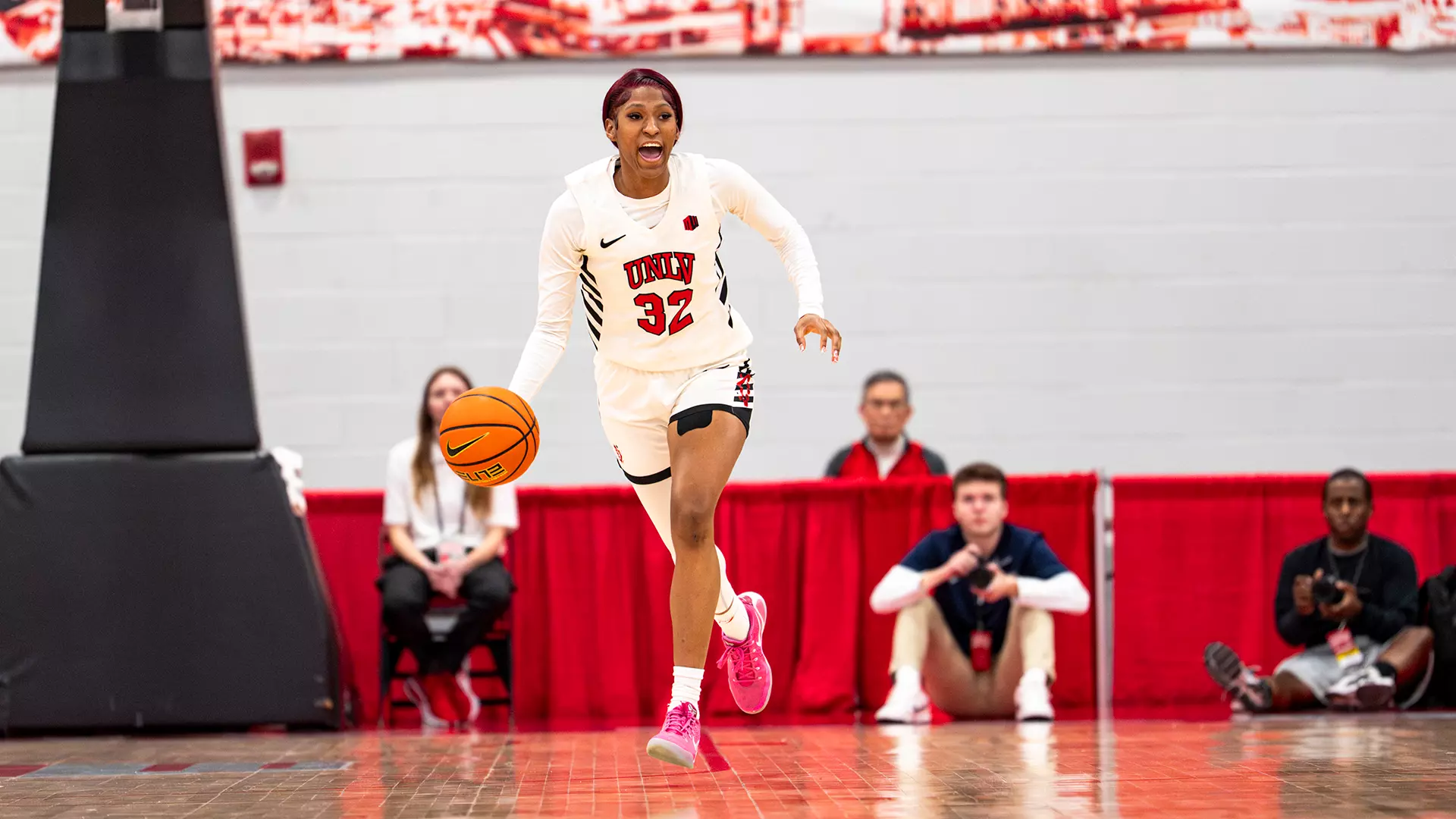
That is not just a great player story. That is a blueprint.

Find the right player. Develop her. Keep her. Let her grow into something bigger than her recruiting profile. Then use that proof to show the next player what is possible at UNLV. That is how programs become real.
La Rocque has also shown that support matters. When asked why she has stayed, she did not only point to family or hometown ties. She pointed to alignment with the athletic department, the university president and the resources around the program. She described Las Vegas as one of the sports capitals of the world and made it clear that the combination of family, institutional support and opportunity makes UNLV too good to leave right now.
That answer matters because it pushes back against one of the most damaging assumptions around UNLV athletics. The assumption is that if someone wins here, leaving is inevitable.
La Rocque has complicated that idea.
She could have chased the next thing by now. That does not mean she never will. It does not mean bigger jobs are imaginary. It does not mean loyalty alone is enough to keep a coach forever. But her staying says something important: UNLV can be a place where the right coach believes there is still more to build.
That is powerful. It should also be instructive.
If UNLV wants to keep successful coaches, it cannot only sell emotion. It has to sell support. It has to sell resources. It has to sell alignment. It has to give coaches a reason to believe staying is not settling. La Rocque is the best current example of that working.
Her comments about a potential general manager role also show why she is not just running a good team. She is thinking like a modern program builder. La Rocque said UNLV is not quite there yet, but she can see the value if the right person fits the program, staff, head coach and university. She also said that if that kind of role eventually comes to women’s basketball, she would want it aligned directly with her program rather than loosely shared across departments.
That is not a throwaway detail. It shows she understands where college sports are going. The job is not just coaching anymore. It is roster management. It is retention. It is recruiting. It is NIL. It is player development. It is planning one year ahead while knowing the entire roster can change in one month. The best programs are becoming more professional. La Rocque understands that reality without abandoning the development principles that made her program work.
That balance is hard. It is also why the Lady Rebels feel more stable than most of the department.
UNLV women’s basketball has not been built on one miracle season. It has not been built on one transfer class. It has not been built on one star. It has been built through repeated standards. That is why the program can lose important players and still expect to win. That is why a down year still looks like 21 wins. That is why La Rocque’s success feels different.
It feels institutional.
That is what UNLV athletics needs more of. Not just big moments. Not just good hires. Not just offseason excitement. Not just press conference optimism. The department needs programs where the baseline keeps moving up and staying there.
La Rocque has moved the baseline.
Now comes the harder part. The Lady Rebels have dominated the Mountain West. They have reached the NCAA Tournament. They have brought attention back to the program. But the next step is obvious. UNLV needs the March win that changes how the program is viewed outside the league.
That is the difference between being a great Mountain West program and becoming something more nationally relevant.
La Rocque has already raised the floor. Now she has to raise the ceiling. That should not be viewed as criticism. It is the consequence of success. When a coach builds a program properly, the questions get harder. Nobody is asking whether UNLV women’s basketball can be good anymore. They are asking how good it can become.
That is what La Rocque has earned. It is also why she is the standard.
She is local, but not limited. She is stable, but not comfortable. She is successful, but not finished. She has turned UNLV women’s basketball into the most reliable winner in the athletic department and one of the clearest examples of what the school should want every program to become.
But it is also bigger than UNLV.
In the NIL and transfer portal era, every program outside the richest leagues is looking for a model that can last. La Rocque has built one in Las Vegas by doing something that sounds simple but is hard to actually sustain. She recruits with purpose. She develops players. She keeps a clear identity. She uses the portal without letting it take over the program. She gives UNLV a reason to believe that winning here does not have to be temporary.
That is why this matters.
Not just that Lindy La Rocque stayed. Not just that she wins. Not just that she is from Las Vegas.
The story is that La Rocque has built the kind of program UNLV keeps trying to describe when it talks about its future. She has made winning normal. She has made stability feel possible. She has made Las Vegas feel like an advantage instead of an excuse. She has shown that UNLV can be more than a stepping stone when the right coach has the right support and the right plan.
Lindy La Rocque is not just part of UNLV athletics.
Right now, she is the standard for it.
And if UNLV is serious about becoming more than a school with potential, it should be studying the program she has already built.