
LAS VEGAS — The next stop in our UNLV football position preview series is the defensive line, a room that has to be better if Paul Guenther’s defense is going to take a real step forward in 2026.
The Rebels have pieces back. Lucas Conti and Landen Thomas both enter the season with preseason All-Mountain West recognition. Mohamed Altayeb returns with program experience. Eliah Logo, Kenji Scanlan and Andre Porter have been on the field. Herb Gray brings Power Four development from Tennessee. Mo Abbasher gives the interior more size. Bryce Waters, Poe Purcell, Prin Fox, Bryce Robinson, Jordan Covington, Kal-El Togafau and Armand Ausbon give the room young bodies to develop.
But this preview is not just about who is back or who arrived. It is about whether UNLV has enough up front to fix one of the biggest problems from last season.
The Rebels finished 2025 with 66 tackles for loss, 30 sacks and 41 quarterback hurries, so the defensive line and pressure package were not empty. UNLV could make plays. It could create negative snaps. It could get into the backfield.
What it could not do consistently enough was control physical run games.
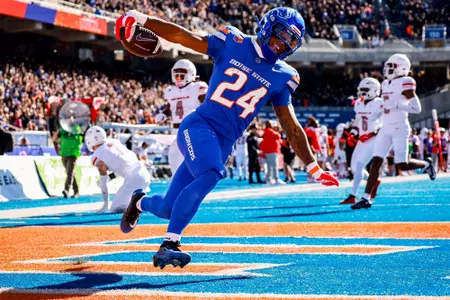
UNLV allowed 177.4 rushing yards per game, 5.2 yards per carry and 24 rushing touchdowns. Air Force ran 66 times for 428 yards and six touchdowns. Boise State ran for 294 yards and three touchdowns in the regular-season meeting, then added 171 yards and two more rushing scores in the Mountain West title game. Ohio ran for 207 yards and two touchdowns in the bowl game. UNR ran for 193 yards and two touchdowns. Utah State ran for 178. UCLA ran for 173.
That is the challenge for Ricky Logo’s room in 2026: replace a lot of defensive-line snaps, get more from the returning pieces and turn last year’s flashes into a front that makes the rest of the defense’s job easier.
The week-to-week defensive numbers made the issue even clearer. In UNLV’s best defensive stretches, the Rebels created negative plays and forced offenses off schedule. In the games where the run defense broke down, that disruption often disappeared.
Air Force was the clearest example. The Falcons ran for 428 yards and six touchdowns, and UNLV finished that game with only one tackle for loss, no sacks and no quarterback hurries. Boise State ran for 294 yards and three touchdowns in the regular-season meeting while UNLV managed just two tackles for loss, one sack and no quarterback hurries. In the Mountain West title game, Boise State ran for 171 yards and two touchdowns while the Rebels finished with one tackle for loss, one sack and one quarterback hurry. Ohio ran for 207 yards and two touchdowns in the bowl game, and UNLV finished with two tackles for loss, one sack and one quarterback hurry.
That is the defensive line issue in one pattern. When the front created negative plays, UNLV could change drives. When it did not, physical offenses were able to stay on schedule, shorten games and force the rest of the defense to keep tackling downhill.
That has to change in Dan Mullen’s second season. The Rebels won 10 games last year and reached another Mountain West championship game, so this is not about a defense that failed completely. It is about a defense that made plays but still had too many stretches where it could not make opponents uncomfortable on early downs.
The first challenge is replacing snaps and production. Tunmise Adeleye was the most productive defensive lineman on the roster last season, playing in 13 games and finishing with 49 tackles, 7.5 tackles for loss, six sacks and six quarterback hurries. Jalen Lee played in all 14 games and added 33 tackles, two tackles for loss and a sack. Ose Egbase also played in all 14 games and had 17 tackles, 1.5 tackles for loss and a sack. Waisale Muavesi played in all 14 and added eight tackles, one tackle for loss and one sack.
That is not just a few names leaving. That is a lot of weekly defensive-line work walking out of the room.
The pressure picture was broader than the defensive line, too. Aamaris Brown and Jaheem Joseph each had 3.5 sacks from the defensive back group. Chief Borders had 11 quarterback hurries from his outside linebacker role. UNLV finished with 30 sacks as a team, but those sacks came from different levels of the defense. Some of that production is gone now, which means the 2026 defensive line has to do more than hold up against the run. It has to create enough pressure on its own that Guenther does not have to solve every passing down with blitzes and pressure packages.
Conti is the starting point.
He is the returning defensive lineman with the clearest mix of production, size and expectation. He played in 12 games last season and finished with 22 tackles, four tackles for loss, 2.5 sacks and a quarterback hurry. Those numbers were not dominant, but they were a step forward. He appeared in two games in 2023, played in 11 games with three starts in 2024, then started 10 of 12 games last season. His role has grown every year.
Now the expectations are growing with it.
Conti enters 2026 as a Phil Steele preseason Second-Team All-Mountain West selection, making him one of the few front-seven players on the roster carrying outside recognition into the season. At 6-foot-5 and 290 pounds, he has the kind of body UNLV needs inside. He has enough size to hold up against physical run games and enough movement to affect the pocket.
His job is not just to flash. It is to become the defensive lineman opponents have to identify before the snap. If Conti becomes more consistent down to down, the entire front changes. Linebackers get better fits. Safeties have less cleanup work. Guenther has more freedom to call the game without constantly sending extra pressure.
Thomas is the other returning defensive lineman with expectation attached.
He played in 11 games last season and finished with 13 tackles, 2.5 tackles for loss, one sack and one pass breakup. Like Conti, he enters 2026 with preseason All-Mountain West recognition, though the projection is based more on what he could become than what he has already proven.

At 6-foot-3 and 270 pounds, Thomas gives UNLV size on the edge. That matters because the Rebels do not need every defensive end to be a speed rusher. They need edge players who can hold up against the run, squeeze gaps and keep the defense from getting widened out.
Thomas does not have to lead the league in sacks to matter. He has to make the edge harder to run at. He has to force backs to cut before they want to. He has to give the pass rush enough physical push to affect pockets from the outside. If Conti is the interior piece with the clearest path to a larger role, Thomas may be the edge player whose jump changes how sturdy the front feels.

Altayeb should not be left out of the picture, either.
He appeared in seven games last season and returns on the 2026 roster as a senior defensive lineman. His 2025 production was limited, with two assisted tackles, but UNLV needs returning front-line bodies who have already been in the program. Altayeb is not starting from scratch. In a room replacing as many snaps as this one, that matters.
That does not mean Altayeb walks into a major role. It means he belongs in the competition. The Rebels lost enough defensive-line work that returning players with size and program experience have to matter. If Altayeb can become more than a depth piece, the room gets older and more stable.

Gray is the transfer who changes the room’s upside, even if he should still be viewed as projection more than proof.
Gray arrives from Tennessee with a 6-foot-3, 290-pound frame and Power Four development. He spent multiple years in Knoxville and worked under longtime Tennessee defensive line coach Rodney Garner, one of the more respected defensive line coaches in college football. That background matters. Gray has been in a serious defensive-line room, around SEC bodies and in a program where the standard up front is high.
But the production is limited. Gray never carved out a major role with the Vols and entered the transfer portal looking for a better path to the field. He saw action in two games, made his collegiate debut against ETSU and recorded one tackle and half a tackle for loss. That is not enough to call him a finished answer. It is enough to understand why UNLV would take the swing.
Gray was a three-star recruit out of Charles Herbert Flowers High School in Maryland, and players with his size and developmental background are worth betting on in the Mountain West. The question is whether the years spent in Tennessee’s program turn into playable snaps in Las Vegas.
If they do, Gray gives UNLV another interior option with real upside. If they do not, the Rebels will need others to carry more of the rotation. His arrival makes the room more interesting. It does not solve the room by itself.

Abbasher is another interior size bet, not a proven addition.
He was on the squad in 2025 but did not appear in any games. At 6-foot-3 and 305 pounds, he gives UNLV the kind of frame it needs inside. The question is whether that size can become usable on Saturdays.
That is the line between having size and having answers. If Abbasher can handle run-down work, occupy blockers and keep guards from climbing cleanly to the linebackers, he gives the Rebels another interior option. Until he proves it, he remains projection, not production.
Logo is one of the more interesting young interior pieces.
He appeared in six games as a freshman and finished with four tackles. At 6-foot-2 and 295 pounds, he gives UNLV another body that can help inside if the development comes quickly enough. His path is not about becoming a star right away. It is about becoming dependable on run downs, holding his gap and giving the Rebels playable snaps when the rotation needs another body.
That interior group may not be the flashiest part of the preview, but it might be the most important. UNLV needs Conti to be good. It needs Gray’s upside to matter. It needs Abbasher, Logo or Altayeb to become more than depth-chart names. More than anything, the Rebels need their size inside to turn into resistance.
The edge depth has to become more reliable, too.
Scanlan played six games last season and finished with four tackles, half a sack and a quarterback hurry. Porter appeared in 13 games and finished with three tackles, half a tackle for loss, half a sack and a quarterback hurry. Rudolph, listed as an outside linebacker, should also be part of the pressure conversation after finishing with 10 tackles, 1.5 tackles for loss and 1.5 sacks.
Those are not headline numbers, but they matter because UNLV needs more playable pressure bodies behind the top names. Pass rush is not only about having one player who can win. It is about having enough sources that an offense cannot slide protection to one side and feel safe.

Scanlan and Porter do not need to become stars. They need to become trustworthy. That means holding the edge, staying assignment-sound and giving Guenther enough rotational snaps that the defense is not dependent on one or two players to create pressure. Rudolph matters because he can change the picture as a lighter edge/hybrid piece if UNLV wants more variety in its pressure packages.
That is part of the challenge for 2026. UNLV’s pass rush came from multiple spots last season. That can be useful in Guenther’s system, but it also creates a question: Can the front create enough on its own?
Blitzes are useful, but they come with a cost. They expose coverage. They create space behind them. They put more pressure on defensive backs to win immediately. The best defenses can rush with four often enough that the coordinator controls the call sheet instead of chasing answers. If UNLV can get more from its defensive line without manufacturing pressure, the entire defense becomes easier to call.
The young defensive linemen give the room a future, even if the 2026 expectation should be reasonable.
Waters, Purcell, Fox, Robinson, Covington, Togafau and Ausbon give UNLV developmental size behind the older competition. The goal should not be to turn every young lineman into an immediate contributor. Defensive line is one of the hardest positions for young players to impact early. The strength jump is real. The technique jump is real. The punishment is real.
But if one of them forces his way into the rotation, that changes the room. Purcell is especially interesting because of the local profile and frame. He comes from Bishop Gorman and is listed at 6-foot-3 and 310 pounds. UNLV needs interior mass it can develop, and a local freshman with that kind of size gives the program something to work with.
The larger point is that UNLV has future size in the pipeline. That matters at a position where relying only on the portal can turn into a yearly reset.
The 2026 defensive line comes down to three questions.
First, can UNLV fix the run defense? The Rebels were good enough to win 10 games last season, but they were too vulnerable when teams could lean on the run. Air Force, Boise State, Ohio, UNR, Utah State and UCLA all ran for at least 170 yards. The more concerning part was how little disruption UNLV created in some of those games. Air Force allowed only one tackle for loss. Boise State allowed two in the regular-season meeting and one in the title game. Ohio allowed only two. That is not one bad afternoon. That is a pattern.
Second, can the defensive line replace lost pressure production? Adeleye transferred. Lee, Egbase and Muavesi are no longer part of the 2026 room. Brown and Joseph are gone from the back end after helping the pressure package. UNLV does not need one player to replace all of that, but it does need the pressure to come from somewhere.
Third, is the rotation deep enough? Conti has recognition. Thomas has expectation. Gray has upside. Altayeb has program experience. Abbasher and Logo give the interior more bodies. Scanlan, Porter and Rudolph give the edge group options. But the season will test more than the top names. It will test whether the second wave can actually hold up.
That is where the defensive line determines the rest of the defense. A strong front makes linebackers look faster. It lets safeties play with better eyes. It turns hurried throws into turnover chances. It makes third-and-long feel like a weapon instead of a relief.
A soft front forces everyone else to compensate. Linebackers have to shed more blocks. Safeties get dragged into the box. Corners have to cover longer. The coordinator has to call pressure because the front is not creating enough on its own.
That is the difference UNLV has to find in 2026.
The Rebels had enough disruption last season to prove the front could make plays. They had defenders who could get into the backfield, win isolated snaps and create negative plays. What they did not have often enough was the ability to make offenses uncomfortable for full drives.
That is what Conti, Thomas and the rest of the room have to change. Conti has to become the credibility piece inside. Thomas has to turn projection into weekly impact. Gray, Abbasher, Logo and Altayeb have to give the interior more resistance. Scanlan, Porter and Rudolph have to create enough pass-rush depth that Guenther does not have to blitz his way through every passing situation. The younger linemen give the room future mass, but the 2026 standard is reliability.
If that happens, the rest of the defense changes. The linebackers can play faster. The safeties can play with better eyes. The corners do not have to cover forever. Guenther can call the game from a position of strength instead of chasing answers.
If it does not, the same problems will come back. Good rushing teams will shorten games. Physical offensive lines will test the interior. Quarterbacks will get too many comfortable pockets. UNLV will still make plays, but it will have to fight too hard to get off the field.
That is why the defensive line is one of the most important rooms on the 2026 roster. The offense may decide how explosive UNLV can be, but the front may decide how stable the entire team becomes. The next step is simple to define and harder to execute: fewer easy rushing yards, more pressure from the line itself and a defensive line that makes everyone behind it better.