
Jackson Arnold brings Dan Mullen more college passing experience. Alex Orji brings a year in Mullen’s offense and another chance after injury ended his first UNLV season. Their summer competition will decide who replaces Anthony Colandrea, whose 14 starts gave the Rebels 3,459 passing yards and 649 more on the ground.
Mullen’s decision reaches beyond which quarterback runs better. Arnold arrives from Auburn after losing the starting job in 2025. Orji returns from a season-ending injury that stopped his first UNLV season after three appearances. Both have started college games; neither enters the summer having recently supplied the sustained passing production the Rebels are replacing.
Colandrea transferred to Nebraska after throwing 23 touchdown passes, completing a school-record 65.9% of his attempts and rushing for 10 scores. He was the first Rebel quarterback to start every game of a full season since Jon Denton in 1996. Whoever wins this competition inherits both the production and the responsibility of giving the offense a dependable starter through a full schedule.
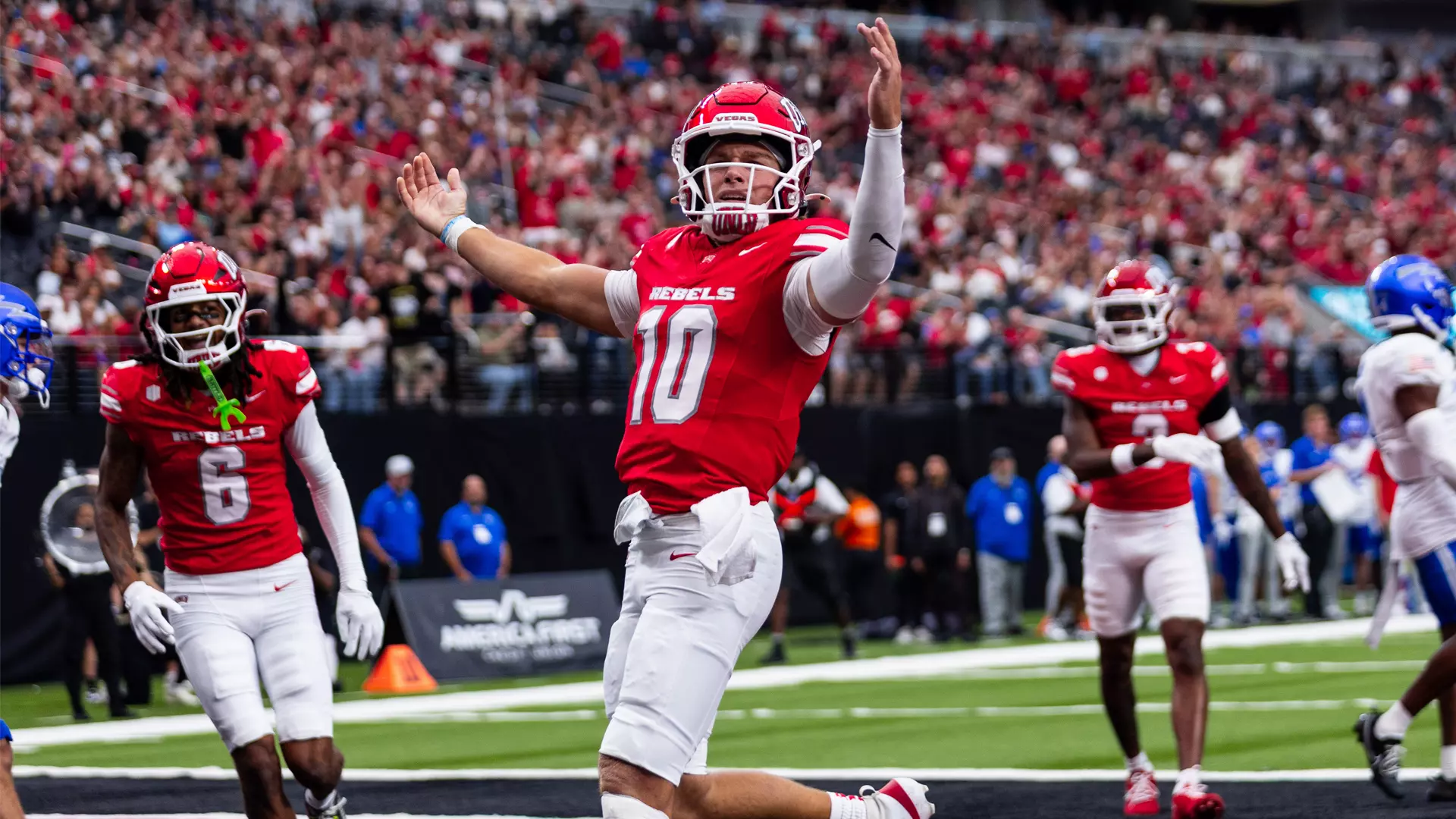
Arnold’s case begins with a considerably larger college passing record than Orji’s. He started at Oklahoma before moving to Auburn, where he threw for 1,309 yards and six touchdowns last season. He also ran for 311 yards and eight scores. UNLV is getting a quarterback with experience handling both responsibilities against major-conference defenses, along with the unresolved problems that kept those responsibilities from becoming a lasting starting job.

His Auburn debut at Baylor showed why Mullen would want that combination. Arnold rushed for 137 yards and two touchdowns in a 38-24 win, adding 108 passing yards. Late in the game, Auburn drove 75 yards in 12 plays, consuming 7:16. Arnold finished the possession by taking fourth-and-1 for a 27-yard touchdown with 4:32 remaining. A conversion that might merely have prolonged the drive instead put the game away.
Against South Alabama, the passing and running responsibilities appeared within the same scoring sequence. Arnold found Horatio Fields for 14 yards on third-and-9, moving Auburn to the 5-yard line before finishing the possession with a touchdown run. He had to make the throw that kept the drive alive before his running ability supplied the points. That combination gives Mullen something useful to develop.
Arnold averaged 6.1 yards per pass attempt at Auburn, compared with Colandrea’s 8.3 at UNLV. Different offenses and opponents prevent a clean comparison. Mullen and offensive coordinator Corey Dennis still need more than occasional productive runs: they have to get enough from Arnold’s passing to sustain possessions when a defense takes those runs away.
Auburn’s official season record gives the contrast a sharper edge. Arnold completed 24 of 28 passes for 251 yards and three touchdowns against Ball State. Later, he threw for 125 yards on 33 attempts at Texas A&M and 137 yards on 31 attempts against Georgia. The productive afternoon belongs in his evaluation, but so do games in which a substantial number of throws moved the offense relatively little.
I would give Arnold’s broader passing experience serious weight. He has made more college throws in more situations than Orji, giving the coaches more to study and specific problems to address. The Ball State performance shows a passing contribution he can make. The Texas A&M and Georgia games show why experience alone cannot settle the job.
Orji’s challenge begins with the chance he lost. The 6-foot-3, 240-pound transfer from Michigan took the first snap of UNLV’s 2025 season, then suffered a season-ending injury against UCLA. He completed all three passes he attempted for 37 yards and rushed 10 times for 42 yards and a touchdown. His season ended before that small collection of plays could become an extended audition.
There was a meaningful contribution inside those limited appearances. Against Idaho State, Orji scored on an 11-yard run in the fourth quarter of the 38-31 opening win. He could help the offense while Colandrea handled its larger passing workload. That is part of his appeal now: Mullen has already found a way to use his running within a game the Rebels needed to win.
The starting job asks for considerably more. Orji’s 2024 Michigan season produced 25 completions on 47 attempts for 150 yards, three touchdowns and two interceptions. Those attempts provide a better starting point for evaluating him as a passer than UNLV’s three-for-three line. They still represent a small workload for someone competing to direct an offense across a full season.
His first Michigan start, a 27-24 victory over USC, illustrates both sides of the argument. Orji completed seven of 12 passes for 32 yards and ran 13 times for 43. He converted third-and-3 with a nine-yard run in the second quarter. In the fourth, a third-and-8 completion to Semaj Morgan lost a yard and preceded a punt. Michigan won with 290 rushing yards, while its passing game supplied very little distance.
Orji’s year in Mullen’s offense gives him familiarity Arnold has to build with a new staff and teammates. His injury limited how much of that work he could put into games.
A situational role remains possible if Orji does not start. Last season showed he could contribute while Colandrea handled most of the passing. Mullen can use that experience without treating a few successful running plays as proof that Orji is ready to direct the entire offense.
Freshman Derek Garcia, a unanimous three-star recruit from Ventura High School in California, has also drawn Mullen’s attention for his work against live defenses.
Mullen called Garcia “an anomaly” and said he might complete only about “30% of his passes on air,” but “all of a sudden you throw a defense around him and he looks like Tom Brady.”

Garcia ranked No. 30 nationally among quarterbacks by ESPN and led Ventura to its first CIF Division 3-AA state championship game appearance. Mullen’s spring assessment gives the freshman an encouraging start, though he has yet to play a college game.
The spring game gave him a concrete moment to carry into the summer. Garcia threw a touchdown to Amorion Walker, who also caught a scoring pass from Orji. Arnold threw a touchdown to Jaylon Glover and ran for another score. Glover’s catch was a one-handed grab.
Returning senior Jai’Den Thomas caught 39 passes for 237 yards and a touchdown in 2025. He gives the eventual starter an experienced receiver out of the backfield as well as an established runner. The spring scoring throws to Walker and Glover showed other ways the quarterbacks could involve the players around them.
Redshirt freshman Sebastian Circo completes the room after seeing no game action in 2025. The Fort Lauderdale, Florida, native and Garcia give Mullen two younger quarterbacks to develop behind the experienced candidates.

UNLV opens against Memphis before traveling to Hawai‘i for an early conference game. My preference is Arnold’s fuller passing record, provided Mullen and Dennis can make it more productive than it was late at Auburn. Orji has familiarity and another opportunity. The summer work has to determine which advantage UNLV can use when the first running lane closes.


