

Joe Moorhead came out of Akron’s 41-7 loss at Minnesota talking about precision.
The Zips had gone on the road against a Big Ten opponent knowing their margin for error would be thin, then spent the afternoon making it thinner. Akron lost a fumble, dropped passes, committed consecutive personal fouls after reaching first-and-goal late in the first half and gave Minnesota short fields through special-teams mistakes. Moorhead believed Akron had done enough defensively early to keep the game available, but not enough anywhere else to take advantage of it. When he reviewed the performance with his team Sunday, Akron had lost all four areas he considers major indicators of winning: explosive plays, turnovers, third down and red-zone touchdowns.
“We just didn’t coach or play well enough to earn the right to win a game against a team of that caliber,” Moorhead said.
That loss is part of the Akron team UNLV will see Saturday. It is not the entire picture.
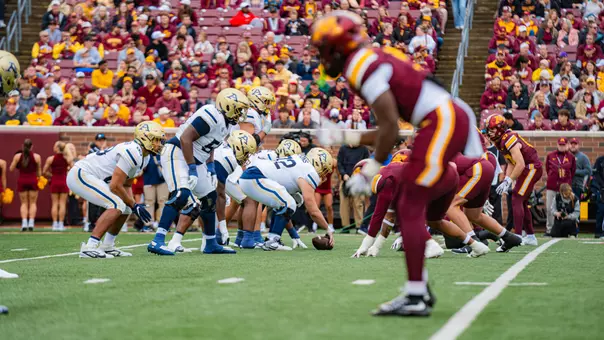
Akron is 1-2 after opening with a 38-16 loss at Wake Forest, beating Robert Morris 45-10 and losing 41-7 at Minnesota. Both losses came on the road against Power Four opponents. The one game against Robert Morris produced 523 yards, 241 rushing yards and 45 points, with the Zips averaging 7.3 yards per play and controlling the ball for more than 35 minutes.
Moorhead has spent five seasons trying to turn Akron from one of the least competitive programs in the FBS into something more stable. The progress has been incremental. Akron won two games in each of his first two seasons, improved to four wins in 2024 and went 5-7 overall and 4-4 in the Mid-American Conference last season, its best finish since 2017. The Zips closed 2025 by winning three of their final four games, including road wins at Buffalo and Bowling Green.
Moorhead described that growth Monday in simple terms. Akron is no longer a program entering every comparable matchup hoping something unusual happens.
“We’ve turned this into a really, really competitive football program that every time we step on the field against a team that’s of similar caliber, we put ourselves in position to win a majority of the time,” Moorhead said.
The roster underneath that progress is still changing quickly. Akron brought back 59 players from last season, but added 48 newcomers, including 32 transfers and 16 freshmen. Sixteen starters returned, nine on offense and seven on defense. That gives Moorhead more continuity than a complete rebuild, but enough turnover remains that several important roles are still being settled through September.
The clearest part of the offense starts in the backfield. Jordan Gant returns after rushing for 1,032 yards and six touchdowns on 213 carries last season, becoming Akron’s first 1,000-yard rusher since Dennis Kennedy in 2008. Gant earned second-team All-MAC honors and gives the Zips a 5-foot-10, 205-pound runner who can handle a conventional workload between the tackles.
Sean Patrick gives Moorhead something different next to him. Patrick rushed for 274 yards and caught 11 passes last season, then showed against Robert Morris how Akron can use him across the formation. He finished that game with 67 rushing yards, 65 receiving yards and 161 all-purpose yards while catching a 35-yard touchdown pass. Gant added 81 rushing yards on 12 carries as Akron finished with 241 on the ground.
That combination is central to how Moorhead wants the offense to work. Akron does not simply call runs to establish the ground game and then move separately into the passing game. The Zips use run-pass options to put a defender in conflict and allow the quarterback to make the decision after the snap. Dan Mullen described it Monday as an offense trying to get itself into the correct answer based on what the defense presents.
“They do a great job with their run to set up the pass,” Mullen said. “It’s a lot of RPO stuff that they do, that they’re going to try to have the perfect play called every single time.”
Cibastian Broughton has made that structure more difficult to defend. The redshirt freshman has completed 53 of 66 passes through three games for 380 yards, four touchdowns and no interceptions, an 80.3 percent completion rate. The passing volume has been modest, but Akron has not asked him to survive exclusively from the pocket. Broughton ran for 82 yards against Wake Forest and 71 against Robert Morris before adding 17 more against Minnesota prior to leaving in the second quarter.
His best game came against Robert Morris. Broughton completed 23 of 27 passes for 227 yards and four touchdowns without an interception while adding 71 rushing yards. Akron put together four touchdown drives of at least 80 yards and scored the final 24 points after halftime. That version of the Zips showed what Moorhead’s offense can look like when the quarterback, backs and RPO game are all functioning together.
Minnesota showed the other side. Broughton completed nine of 13 passes for 42 yards before leaving in the second quarter, and Akron finished with only 221 yards and 56 rushing yards. Brayden Roggow replaced him and went 12-for-25 for 131 yards, directing the Zips’ only touchdown drive late in the fourth quarter. Akron was 3-for-13 on third down and reached the red zone twice.
Broughton’s status now becomes the most important personnel question entering Saturday. Moorhead did not provide a definitive availability update in the material available Monday, while Mullen said he saw Broughton moving around late in the Minnesota game and made clear UNLV is preparing for either quarterback. Roggow is not an emergency option who had never played. He appeared in three games last season and has completed 24 of 38 passes for 231 yards and two touchdowns this year.
Akron is also still sorting out who becomes the most dependable target around the quarterbacks. Gentz Hilburn, a junior-college transfer who had not played an FBS game before this season, caught three passes for 49 yards at Minnesota and produced two catches for 47 yards on Akron’s fourth-quarter touchdown drive. Moorhead said Hilburn had earned consideration for a larger role because of his practice habits, special-teams work and what he did when the ball reached him.
“He’s making plays when the ball comes his way,” Moorhead said. “He’s catching the ball and he’s getting yards after the catch.”
The offensive problem for Akron has been making that production hold against better competition. Wake Forest allowed Broughton to hurt it with his legs but still held the Zips to 305 yards. Minnesota squeezed the rushing game, created obvious passing situations and eventually forced Akron into a game it could no longer play on its terms. Moorhead said part of the Minnesota problem began before kickoff, describing the week of practice as inconsistent and repeating one of his core coaching beliefs: “practice habits tend to become game realities.”
That gives UNLV a relatively clear defensive assignment. Akron wants to establish enough run success to make the RPO game comfortable, then force linebackers and safeties to declare themselves before the quarterback makes the final decision. The Rebels do not need to solve that by creating something exotic. They need to fit the run correctly and finish tackles once the ball gets into space. That becomes particularly relevant after Mullen said UNLV missed 29 tackles at North Texas.
The defense Moorhead brings into Saturday has a different issue. Akron rebuilt the middle of the unit, especially at linebacker, and has been using September to give inexperienced players live repetitions before MAC play begins. Moorhead singled out Donelius Johnson, Dwight Nunoo and freshman Daunte Curtis as the three linebackers making the most progress. Johnson, a Kennesaw State transfer, led Akron with 12 tackles and 1.5 tackles for loss at Minnesota after recording 11 tackles against Wake Forest.
“The two guys playing the best are Donelius Johnson, the kid we brought in from Kennesaw, and Dwight Nunoo,” Moorhead said. He also called Curtis “a really, really good player” in development and said Akron’s early nonconference schedule has given the young group valuable repetitions before league play.
The defensive front is where Mullen’s first scouting comments were strongest. He called Akron’s defensive line “big time,” praised its linebackers and described the secondary as athletic. Minnesota eventually ran for 191 yards, but 71 came on one play, and Moorhead believed the run defense had held up reasonably well before late-game yardage changed the final total. What frustrated him more was the same thing that hurt Akron against Wake Forest: explosive plays. Minnesota produced a 71-yard run and Akron also allowed a 64-yard punt return that created another short field.
Moorhead’s own scouting report of UNLV helps explain how Akron expects to play the matchup. He described Jackson Arnold as a passer who can still hurt a defense with his legs and said Akron is preparing to see Alex Orji in some capacity. He called Jai’Den Thomas one of the best running backs Akron will face this season and spent considerable time on UNLV’s defensive multiplicity, noting Paul Guenther’s ability to move between three- and four-man fronts, change personnel and play both split-safety and single-high coverages.
That preparation cuts against the easiest reading of the matchup. Akron is not approaching UNLV as a damaged 1-2 team arriving after a 38-point loss. Moorhead called the Rebels “well resourced, well coached, incredibly talented” and talked through UNLV’s personnel as a team Akron will need its best performance to beat.
The same should be true in the other direction.
Akron has not shown enough through three games to be mistaken for a finished team. Its offense went from 523 yards against Robert Morris to 221 at Minnesota. Its quarterback situation is unsettled entering the week. The defense has allowed explosive plays in both Power Four losses, and Moorhead is still developing young players at positions that were major offseason questions.
The Zips are also further along than the Akron teams that spent years near the bottom of the FBS. They won five games last season, returned a 1,000-yard back, found a redshirt freshman quarterback who has yet to throw an interception and built enough depth through the portal that several young and inexperienced players are now competing for meaningful roles instead of being forced into them by default. Their best performance showed an offense capable of sustaining long drives and producing more than 500 yards. Their worst showed how quickly the structure can unravel when the run disappears and self-inflicted mistakes pile up.
That is the Akron team UNLV has to prepare for Saturday. Moorhead wants the run game to create the passing game, wants the quarterback to make the defense wrong through RPO decisions and has spent five years building a roster he believes can beat comparable opponents when it plays clean football. UNLV does not need to turn Akron into something it is not. The Rebels do need to understand what the Zips have become.
See something that needs correcting? Report a correction.