

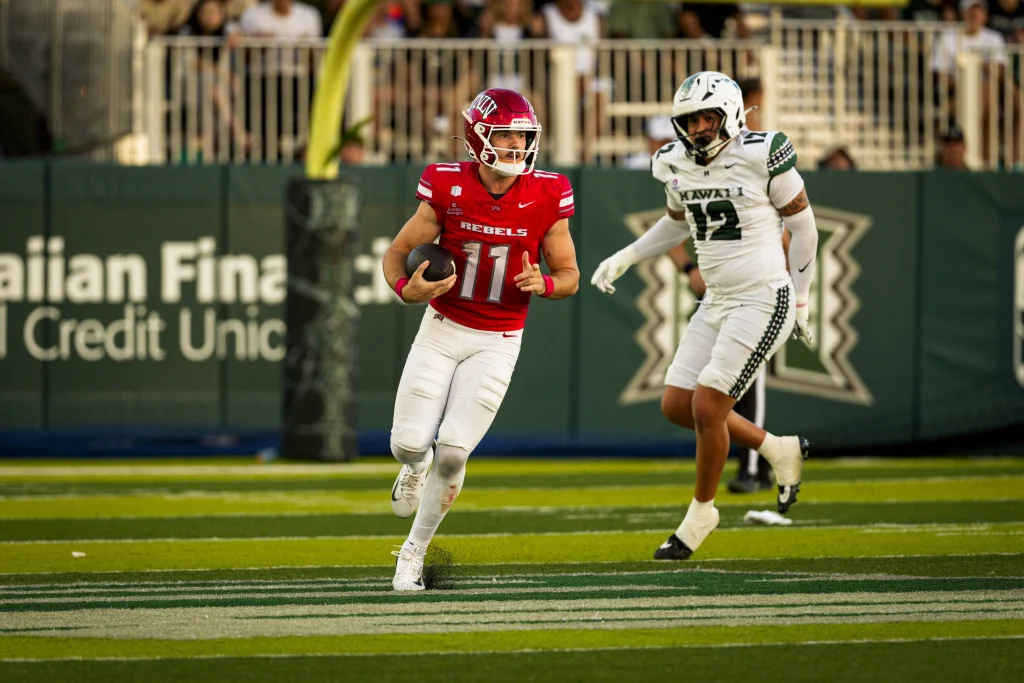
LAS VEGAS — Jackson Arnold gave UNLV five touchdowns against Cal. The Rebels also gave the Bears a blocked punt, an onside-kick recovery and a fumbled kickoff return. They survived all three in a 39-31 win, but North Dakota State arrives Saturday with a defense that has already scored three touchdowns and an offense that has lost the ball only three times.
UNLV has enough offense to challenge the unbeaten Bison. It needs considerably fewer mistakes around that offense to keep the opportunity intact.
The Rebels are 3-2 and 1-0 in the Mountain West after consecutive wins over Akron and Cal. NDSU is 5-0 and 2-0, with conference wins over Air Force and Wyoming. Saturday’s Homecoming game is the programs’ first meeting, with kickoff at 4:10 p.m. PT at Allegiant Stadium and television coverage on The CW.
“It’s the next conference game,” Dan Mullen said. “Which means it’s a big one.”
Both offenses are averaging 5.8 yards per play. UNLV has generated 392.6 yards per game to NDSU’s 377.8, but the Bison have been much better at limiting what happens when the other team has the ball. They allow 236.2 yards per game, compared with UNLV’s 384.2, and have outscored opponents 168-49.
Those totals need context. NDSU shut out Fordham, an FCS opponent, and held Wyoming’s struggling passing offense to five completions last week. Air Force gained 386 yards and nearly erased a 35-13 deficit. UNLV’s offense has varied sharply, too, scoring six points at North Texas before producing 38 at Akron and 39 against Cal. Neither team’s season average tells the whole story of what it can do Saturday.
Arnold gives UNLV its best opportunity to make the Bison defend differently. He enters with 1,063 passing yards, eight passing touchdowns and no interceptions on his own throws, along with 270 rushing yards and five scores. Against Cal, he threw touchdowns of 70 yards to Kayden McGee and 36 to Taz Reddicks, then found Keyan Burnett for the go-ahead score in the fourth quarter.
WELCOME BACK, BIG PLAY MCGEE.
— The Scarlet Standard (@SS_MediaLV) October 3, 2026
On 3rd-and-8, Jackson Arnold drops one in to Kayden McGee and McGee takes it 70 yards to the house.
UNLV’s offense had done absolutely nothing through its first two drives. One play changes that in a hurry.
Cal 7, #UNLVFB 7 | 5:31 1Q
Cal concentrated extra attention on Jai’Den Thomas, holding him to 46 yards on 16 carries. Arnold attacked behind the defenders coming forward and ran for another 110 yards. NDSU has to handle both possibilities while avoiding the missed sacks Tim Polasek counted against Wyoming.
“We missed three sacks, and we got to get the guy to the ground,” Polasek said. “That’s going to be important in this next matchup. This guy’s a strong athlete.”
Arnold against linebacker Donovan Woolen is one matchup worth following from the opening possession. Woolen can threaten pressure, attack a handoff or stay underneath a receiver. He intercepted Wyoming’s first pass, came unblocked for a sack and finished with nine tackles and 1.5 tackles for loss. His responsibilities can change after Arnold has made his initial assessment of the defense.
Mullen can make Woolen choose by combining Thomas’ running action with an Arnold keep or a route behind the linebacker. If Woolen attacks the back, Arnold can have room outside. If he pursues Arnold, a receiver can become available behind him. But the offensive line has to account for Woolen actually rushing. A favorable design does little if an unblocked defender reaches Arnold before the play develops.
NDSU defensive coordinator Grant Olson also has ways to encourage a quick throw into coverage. Against Jacksonville State, the Bison showed third-down pressure before dropping eight defenders. Caden Creel checked underneath, and NDSU made the tackle short of the marker. Arnold needs to confirm which defenders leave and which remain rather than throw solely because the alignment suggested a blitz.
Thomas against NDSU’s interior is just as important. Jet has 383 rushing yards at 5.2 per carry, plus 12 catches for 108 yards. The Bison allow 102.2 rushing yards per game and three yards per attempt, with defensive tackles Keenan Wilson and Logan Larson helping prevent blockers from reaching the linebackers.
UNLV cannot let repeated losses make Arnold responsible for rescuing every possession. Productive carries from Thomas would give Mullen more room to use play-action and quarterback runs. Getting Thomas involved as a receiver can also make a linebacker tackle him away from the defensive front instead of letting Wilson and Larson determine where the first contact happens.
Center Austin Boyd remains out with the ankle injury that has sidelined him since the fourth quarter against Memphis. UNLV has already played without him, but protection communication remains a major assignment against Woolen and the Bison’s changing pressure looks. The Rebels have allowed 14 sacks through five games. NDSU has nine, with Kelton McCaslin contributing three.
McGee and Reddicks are the receivers to watch when NDSU commits another defender toward the run. Reddicks leads UNLV with 14 catches for 272 yards and averages 19.4 yards per reception. McGee has eight catches for 188 yards, averaging 23.5, and returned against Cal with three receptions for 85 yards after missing Akron.
Their speed gives Arnold a reason to challenge a safety who moves forward too quickly, but those routes need time. If NDSU can pressure with its front while leaving help over the receivers, UNLV will have to earn completions underneath and stay ahead of third-and-long. The Bison have intercepted eight passes while allowing three passing touchdowns.
Burnett can help Arnold identify that coverage. UNLV has detached the tight end from the line and used him in motion, allowing the quarterback to watch whether a defender follows or the defense adjusts its assignments. That movement provides information, though it does not guarantee the coverage will remain unchanged after the snap.
Burnett has nine catches for 99 yards. His 10-yard touchdown on third-and-8 against Cal came after Arnold’s 42-yard run moved UNLV into scoring position. With DeAngelo Irvin Jr. still out because of an arm injury, Burnett’s ability to work inside gives Arnold another receiving threat while McGee and Reddicks stretch the field.
KEYAN BURNETT.
— The Scarlet Standard (@SS_MediaLV) October 3, 2026
On 3rd-and-8, Jackson Arnold finds Burnett for a 10-yard touchdown and UNLV finally answers.
After watching a 24-7 lead disappear, the Rebels go 80 yards in five plays and take the lead right back.
“They’re gonna do the simple things, so we have to do simple better,” Burnett said of NDSU. “Just continue to stay on our technique and really just execute.”
UNLV’s defense has a different problem: create pressure without helping the Bison’s running game. The Rebels have 14 sacks and 26 tackles for loss, compared with NDSU’s nine and 22. Those are team totals, and safety Tre Fulton leads UNLV with 3.5 sacks. Kal-El Togafau has three, while Andre Porter and Elias Rudolph have two apiece.
Another big time sack for the Rebs
— UNLV Football (@unlvfootball) September 5, 2026
Togafau and Porter against NDSU’s offensive line deserve particular attention. Togafau has 16 tackles and 3.5 tackles for loss; Porter has four tackles for loss. They have to win blocks while remaining responsible for their gaps. An end crashing toward Scott can give Hayes the read to keep the ball, and a pass rusher getting too far upfield can leave a scramble lane.
Hayes completed 75 of 116 passes for 995 yards, seven touchdowns and two interceptions through the first five games. His running became more prominent against Wyoming, when he gained 79 yards and scored twice on 10 carries. Polasek said the Bison had called those concepts previously without getting the same opportunities for Hayes to keep.
Wyoming had NDSU backed up at its own 3 early in the second quarter. Hayes gained nine yards on a sneak, then 18 on a keeper. Jackson Williams added 13 on a run and caught a contested 35-yard pass before Hayes finished with a 14-yard touchdown. The Bison traveled 97 yards in seven plays.
Bison 14, Wyoming 0.
— NDSU Football (@NDSUfootball) October 3, 2026
On another keeper, Wyoming’s defensive end followed the back while a linebacker moved outside for Hayes. Kessel crossed the formation and blocked that linebacker, allowing Hayes to gain 19. UNLV needs the defender handling the quarterback to recognize the incoming block and keep leverage toward the sideline. Assigning somebody to Hayes is only the beginning of defending him.
Larson can create those decisions without changing personnel. Kokat, a 250-pound tight end who also performs fullback duties, can lead Scott through the middle, help him outside or release into a route. Kessel can block near the line and catch passes behind linebackers who react to the same initial movement.
Scott leads NDSU with 298 rushing yards and four touchdowns. Mitchell has 214 yards and three scores in four games and was not listed on Thursday’s initial availability report after missing Wyoming. His return would give Larson another established runner alongside Scott, although that report does not substitute for final game-day availability.
The Bison also listed guard Griffin Empey and backs Cortez LeGrant and Barry Kpeenu as questionable. Empey’s status could affect an interior that UNLV wants to challenge with changing fronts and pressure. For the Rebels, Cohen Fuller remained questionable while awaiting eligibility clearance; he has not played this season, and the designation is not injury-related.
Guenther can force Hayes and his blockers to make protection decisions by moving between odd and even fronts, placing a defender over the center and threatening pressure from several positions. NDSU has allowed seven sacks. Jacksonville State forced a delay of game while Hayes adjusted the protection and later intercepted him against third-down pressure. Air Force forced a punt when Dallas Daley beat Mitchell’s block off the edge.
Jake Pope’s communication and Fulton’s recognition become important behind those fronts. Pope has 36 tackles and helps organize the secondary. Fulton leads UNLV with 37. Both must account for run action without allowing Williams or Kessel to get behind them.
Williams against UNLV’s coverage may be NDSU’s best opportunity for a long gain. He has 22 catches for 358 yards, and Larson moves him inside and outside while also using him on carries. Against Wyoming, Williams turned a quick throw against a cushion into 25 yards after making the first defender miss. He later finished the contested 35-yard catch against tighter coverage.
UNLV has allowed 249.8 passing yards per game. Cal’s 91- and 53-yard touchdown passes accounted for 144 of its passing yards last week, and Williams can test both the initial tackle and the coverage downfield. Giving him room underneath only works if the first defender brings him down.
Kessel makes that coverage assignment harder for the linebackers. He has 13 catches for 150 yards, including a 30-yard reception on third-and-6 against Wyoming. Against Air Force, hard play-action drew defenders toward the line before he released behind them. The Rebels cannot have every second-level defender following Scott while Kessel runs into the space they leave.
Third down and the red zone could separate possessions that look similar between the 20s. UNLV converts 38.2% of third downs; NDSU converts 43.1% and has made eight of 12 fourth-down attempts. The Bison have held opponents to a 33.9% third-down conversion rate, so the Rebels need to avoid asking Arnold to repeatedly throw beyond the marker against a defense expecting it.
UNLV has scored touchdowns on eight of 15 red-zone trips. NDSU has allowed four touchdowns in 10 opponent trips and only five scores altogether. Wyoming reached the 1 after recovering a fumble last week, then lost ground on a false start and failed on fourth down. UNLV needs to protect those opportunities from penalties and negative plays.
The Rebels also have to remain alert when NDSU faces fourth-and-short. Against Air Force, Hayes threw a slant to Mekhi Collins on fourth-and-2. The Falcons concentrated on the expected run, Collins won inside against his defender and the play became a 44-yard touchdown.
Nathan Hayes to Mekhi Collins for the touchdown!
— NDSU Football (@NDSUfootball) September 12, 2026
Special teams could make every one of those possessions easier or harder. Williams has a 40-yard punt return this season. Klein is 9-for-9 on field goals, including a 56-yarder at Air Force, while UNLV’s Ramon Villela has made four straight after missing his first attempt.
UNLV does not need a spectacular return to improve on last week. It needs the punt protected, the catch secured and everybody prepared for the possibility of an onside kick. NDSU’s plus-eight turnover margin has helped it score without sustaining another long offensive drive. Arnold has protected the ball on his passes, but exchanges, return decisions and special-teams assignments remain part of that advantage.
The Rebels’ route to a third straight win starts with keeping Thomas productive enough to make NDSU defend the handoff, then using Arnold and the receivers when that attention creates space. On defense, the pressure has to produce longer downs without losing Hayes outside or Williams behind the coverage. A punt or turnover only helps if UNLV finishes the next possession.
“I think this is a little bit about which quarterback performs the best and gives his team the best chance at the most successful plays,” Polasek said.
See something that needs correcting? Report a correction.