

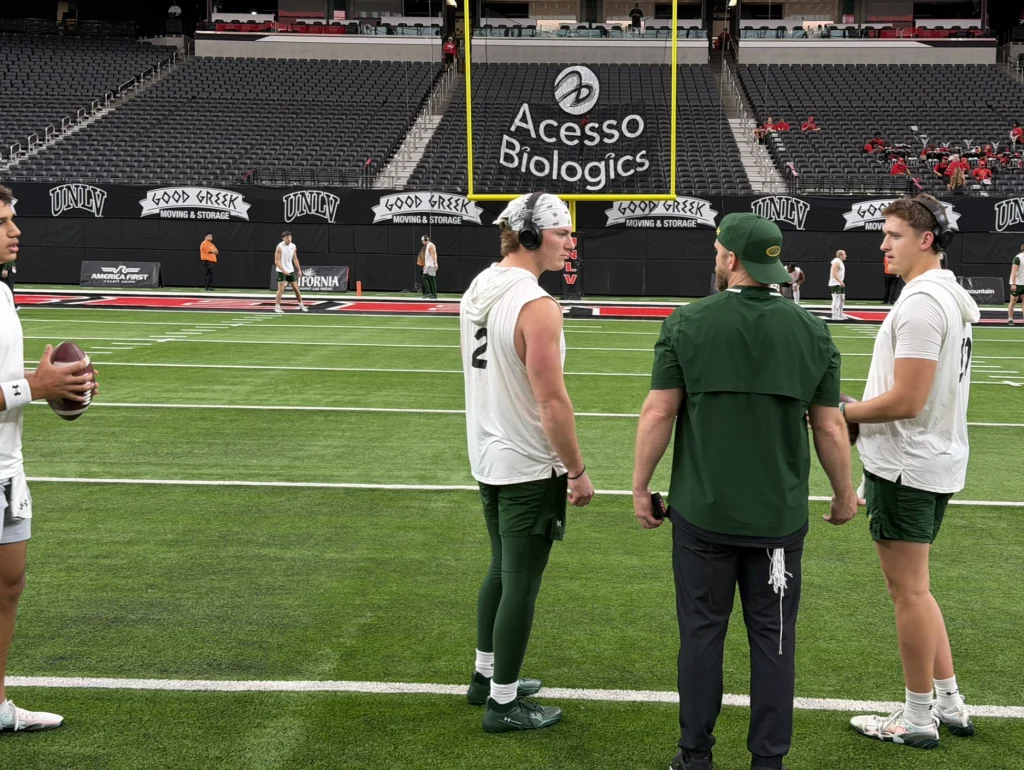
Nathan Hayes entered Saturday’s game against UNLV with a bruised toe, a walking boot that had already drawn attention and two interceptions through North Dakota State’s first five games. He left Allegiant Stadium with three more interceptions and the Bison’s first loss. The injury immediately became part of the explanation for NDSU’s 13-7 defeat. It belongs in the conversation, but it does not explain everything the Rebels forced Hayes to confront.
Hayes completed 12 of 22 passes for 124 yards, and North Dakota State scored only once despite gaining 300 yards. UNLV’s defense intercepted him three times, including a touchdown return by Andre Porter and two takeaways by Mumu Bin-Wahad. The larger issue was not simply whether Hayes could move or throw with an injured toe. It was what happened when his first option disappeared and he tried to make something out of a play that was no longer there.

Tim Polasek had identified that concern before the game. “I think the area that he can still grow in is, okay, it’s bad, it’s bad, move on and keep us ahead of the chains,” the NDSU coach said during the week. Cody Kessler raised a similar point before Hayes threw his first interception. During the CW broadcast, Kessler praised his arm strength and mobility but questioned his tendency to trust his arm rather than take what the defense gave him.
The injury reporting was real, too. Jeff Kolpack reported that Polasek had acknowledged the bruised toe and that Hayes was not listed as questionable. Dom Izzo reported the toe issue but said Hayes was “good to go.” That establishes why Hayes’ health was being discussed before kickoff, not how much pain he experienced or whether the toe affected a particular throw. The broadcast cannot answer those medical questions. It can show the decisions Hayes made and the defensive plays that followed.
Those decisions were worth examining before UNLV. Against Jacksonville State, Hayes completed 14 of 22 passes for 160 yards, two touchdowns and an interception. He escaped pressure to find Jackson Williams on fourth-and-11, but also failed to beat the play clock while adjusting protection and threw an interception against third-down pressure. The same willingness to keep looking for a play could produce a first down or leave the offense in worse position.
The counterexamples matter. Hayes completed 18 of 22 passes for 210 yards and two touchdowns without an interception against Fordham. At Air Force, he threw for 228 yards and two touchdowns while adding a rushing score, including a fourth-down slant to Mekhi Collins that became a 44-yard touchdown. Against Sacramento State, Williams caught seven passes for 134 yards. At Wyoming, Hayes ran for 79 yards and two scores while completing 14 of 25 passes for 187 yards. North Dakota State had won with Hayes operating on schedule and with Hayes improvising when a play broke down. The question against UNLV was whether he could recognize the difference.
The Rebels challenged that judgment almost immediately. On the opening possession, Hayes completed a pass to Williams under pressure from Elias Rudolph, but an offensive hands-to-the-face penalty erased the gain and left NDSU facing third-and-23. That stalled drive was not a quarterback decision problem. Hayes had made the throw. His offensive line’s penalty took it away, a distinction that matters when explaining why NDSU struggled to sustain possessions.
The next series was different. After Hayes kept the ball for 12 yards, he attempted a quick pass toward Collins. Porter read the quarterback, raised his hands into the throwing lane and intercepted the ball for UNLV’s only touchdown. Polasek credited Porter for an excellent play on the run-pass option, and Kessler explained how the defensive end recognized the hitch. Nothing about that snap establishes a bad plant or altered release because of Hayes’ toe. Porter anticipated the throw and made the play.
Hayes then showed exactly why NDSU trusted him to extend possessions. On third-and-11, he escaped pressure and found Reis Kessel for 28 yards. UNLV ran a twist up front but lost outside contain, giving Hayes room to move while keeping his eyes downfield. The completion punished a defensive mistake and kept the drive alive. It also created a telling contrast with the very next snap.
Hayes tried to reach Chris Kiel with Bin-Wahad underneath and Trey Fulton deeper in coverage. Bin-Wahad occupied the short passing lane, while Fulton limited the room behind him. Kessler argued that Hayes should have checked the ball down or thrown it away instead of forcing a pass between two defenders. The throw to Kessel had been available after the defense lost contain. The throw toward Kiel challenged coverage that was already in position. Bin-Wahad intercepted it.
North Dakota State did eventually find a way to beat the defense without requiring Hayes to rescue a broken play. The Bison established their running game and used Preston Brown in a designed quarterback package before Hayes returned. Brown’s appearance alone does not establish an injury substitution. A holding penalty erased a Myles Mitchell touchdown, and a false start backed NDSU up, but Hayes recovered to find Kiel for a 21-yard touchdown.
That score came from the offense creating space for its quarterback. Motion and a pulling guard drew UNLV’s linebackers toward the run, allowing Kiel to release behind them. Kessler identified those movements on the replay, and Hayes delivered from the pocket. The play tied the game at seven and showed the Bison could still manufacture a clean passing window when the run action influenced the defense.
UNLV made those windows harder to find after halftime. Denver Harris stayed with Collins on a downfield attempt and contested the throw. On a later third-and-six, the Rebels showed pressure before dropping a defender underneath into Hayes’ passing lane. Kessler identified that defender as a factor in a high incompletion toward Williams. UNLV threatened a rush without abandoning the quick throw behind it. That is one observed example of how the defense complicated Hayes’ read, not proof that the Rebels used the same coverage on every snap.
Williams’ lack of production was another part of the story. He had provided a 51-yard catch against Air Force, seven receptions against Sacramento State and a contested gain on Wyoming’s long touchdown drive. His first official catch against UNLV did not come until the Bison’s final possession. NDSU still drew defensive holding and pass-interference penalties on downfield attempts, so the coverage was not flawless. But Williams was no longer repeatedly turning difficult downs into the gains that had supported Hayes earlier in the season.
The Rebels also won plays that had little to do with his throwing decisions. Tony-Louis Nkuba beat a block to stop a screen behind the line, and UNLV stopped two fourth-down runs, including Mitchell’s attempt from NDSU’s own 18 early in the fourth quarter. DJ Scott departed with his arm in a sling, limiting the available backfield. Later, Porter beat his blocker on third-and-14, reached Hayes and knocked the ball loose. NDSU recovered, but the sack ended the possession. That was a protection loss, not a quarterback forcing a throw into coverage.
North Dakota State still had a chance on its final drive, and Hayes showed that his mobility had not disappeared. He stepped up against a four-man rush to find Williams, watched Mitchell convert a short third down and scrambled 28 yards to UNLV’s 24. The run cannot establish that his toe felt fine. It does show that he retained the ability to escape and gain significant yardage with the game on the line.
The next play changed the situation. Hayes kept the football on a run-pass option as coverage rotated toward Collins, and Dee Crayton dropped him for a seven-yard loss. Kessler explained that NDSU had called a run with a backside passing option and believed Hayes should have handed it off. He also noted that throwing the ball away could have drawn an illegal-man-downfield penalty because the linemen were blocking for the run. That was Kessler’s reading of the play, not a confirmed account of the coaches’ instructions.
A holding penalty then pushed the Bison into second-and-27. Hayes escaped Porter and looked for another play downfield rather than accepting the failed snap. Bin-Wahad intercepted the pass, ending NDSU’s last opportunity. Kessler again questioned the decision to force the throw when Hayes could have preserved another down.
The toe injury remains an unanswered part of Hayes’ performance. Neither the walking boot nor his late scramble can tell us how much it affected his comfort or mechanics. But UNLV’s defense supplied clearer explanations for the result: Porter recognized a quick throw, Bin-Wahad occupied a covered passing lane, the rush won key matchups and Hayes made a costly read on the final drive. Polasek had asked his quarterback to recognize when a play was gone. With North Dakota State’s last chance on the line, UNLV made him face that decision again.
See something that needs correcting? Report a correction.