

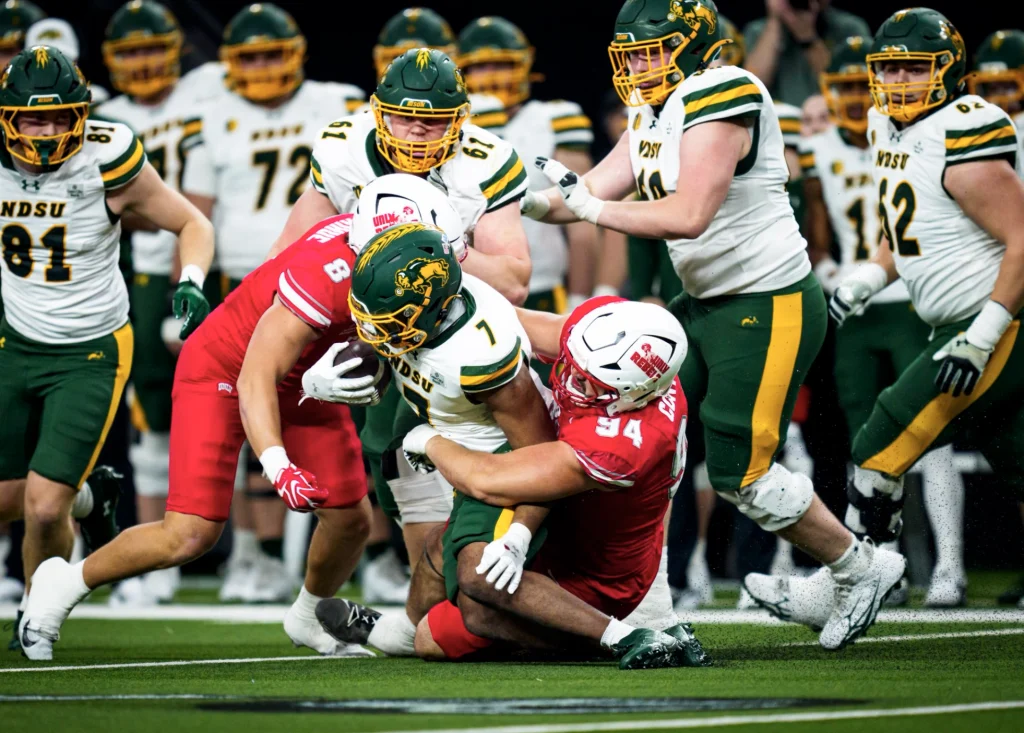
LAS VEGAS — North Dakota State came to Allegiant Stadium undefeated, carrying the reputation of one of college football’s most successful programs into its first season in the Mountain West. The Bison had won their first five games, shut out Wyoming the previous week and appeared ready to compete in the conference immediately. UNLV handed them their first loss Saturday, but it was not because the Rebels controlled the game offensively.
The defense intercepted Nathan Hayes three times, scored on Andre Porter’s first-quarter pick-six and held North Dakota State to one touchdown in a 13-7 victory. UNLV managed just 255 yards of offense, never reached the end zone and needed nearly every defensive stop to survive. North Dakota State outgained the Rebels 300-255, but could not turn that advantage into points when the opportunities came.
It was the kind of afternoon that demonstrated how far UNLV’s defense has come while exposing how much work remains for Dan Mullen’s offense. Against California a week earlier, the Rebels needed 39 points to win. Against North Dakota State, they needed their defense to score.
Three Interceptions Changed the Game
North Dakota State entered Saturday at 5-0, fresh off a 28-0 shutout of Wyoming in which the Cowboys completed only five passes. Tim Polasek’s Bison have built their success around disciplined execution and an ability to make opponents play on their terms. UNLV challenged that approach almost immediately.
Porter, the Las Vegas native, came off his blocker, recognized Hayes’ intended target and undercut the throw for a touchdown. The interception return gave UNLV a 7-0 advantage before its offense had established any rhythm, and it turned out to be the only touchdown the Rebels would score all afternoon.
Mumu Bin-Wahad intercepted Hayes later in the opening quarter and added another takeaway in the fourth. North Dakota State found opportunities to move the football, particularly when Hayes extended plays after the initial design broke down, but UNLV’s secondary punished the quarterback for trying to manufacture a big play. Hayes finished 12-for-22 for 124 yards, one touchdown and three interceptions.
The turnovers were more than isolated highlights. They gave UNLV a lead it could protect while keeping the Bison from settling into a rhythm. Without Porter’s touchdown and the defense’s ability to steal possessions, the Rebels’ offensive production would have left very little chance to win.
North Dakota State Moved the Ball but Could Not Finish
Holding the Bison to seven points was impressive, but it would be misleading to suggest UNLV shut down their offense. North Dakota State rushed for 176 yards, averaging 4.5 yards per carry, and finished with 18 first downs. The Bison moved the football often enough to remain dangerous; what they could not do was finish drives.
One of UNLV’s most important stops came in the second quarter. On fourth-and-1 at the Rebels’ 9, Jake Pope and Justin Flowe stopped Nyeoti Punni for no gain, ending a seven-play North Dakota State possession without points.
Hayes eventually connected with Chris Kiel on a 21-yard touchdown pass to tie the game at seven. Drew Klein missed a 53-yard field goal before halftime. North Dakota State went 4-for-12 on third down and failed on both fourth-down attempts, leaving scoring opportunities unfinished.
UNLV recorded two sacks and six tackles for loss, but it still surrendered productive runs. That distinction matters heading into the next conference game. The defense did not win every snap; it won the possessions that had the greatest impact on the scoreboard.
Jackson Arnold and the Passing Game Took a Step Back
A week after accounting for five touchdowns against California, Jackson Arnold encountered a North Dakota State defense that gave him little room to operate. He completed eight of 16 passes for 77 yards and threw his first interception of the season when linebacker Ray James Jr. stepped in front of a pass in the second quarter. UNLV went into halftime tied despite having generated 135 yards of offense and no offensive points.
The Bison consistently made the Rebels work through multiple downs rather than allowing one explosive play to change a drive. UNLV could gain yardage on the ground and still fall behind schedule on the next snap, leaving Arnold to operate in predictable passing situations. The offense finished 5-for-15 on third down.
Against California, Arnold’s ability to extend plays and challenge defenses downfield made the Rebels difficult to defend. North Dakota State largely took away those opportunities and forced UNLV to execute consistently over longer possessions. The Rebels rarely answered, and even a defense that created three interceptions could not give its offense a comfortable lead.
Jet Thomas Was UNLV’s Most Reliable Offensive Option
When the passing game stalled, Jai’Den “Jet” Thomas gave UNLV something it could trust. He briefly left the game in the second quarter before returning to become the focal point of the Rebels’ offense. His physical running was especially important after halftime, when neither team could establish much sustained momentum.
Thomas accounted for 55 of UNLV’s 88 yards in the third quarter, including two hard runs that helped move the Rebels into scoring range. The drive ended with a 29-yard field goal from Villela, giving UNLV a 10-7 lead. Thomas could create positive gains against a disciplined front, but the offense could not regularly build on those gains.
UNLV rushed for 178 yards as a team, yet averaged only 3.7 yards per carry. As the Bison concentrated on limiting Thomas and the rushing attack, the passing game failed to consistently make them pay. Thomas kept the Rebels moving in stretches. He could not fix their inability to finish drives by himself.
UNLV’s Defense Outscored Its Offense
The final score tells an unusual story. UNLV scored 13 points. Seven came from Porter’s interception return, while the offense managed six on two field goals. The Rebels possessed the ball for 33 minutes and 28 seconds but never scored an offensive touchdown.
North Dakota State’s defense deserves credit. The Bison contained the passing game, created Arnold’s interception and forced UNLV to settle for field goals on both of its red-zone trips. The Rebels had opportunities to create separation and repeatedly left the Bison within one score.
That inability to finish placed an extraordinary burden on the defense. North Dakota State was one touchdown away from taking the lead late, and UNLV could not afford the kind of coverage mistake or missed assignment that had troubled it earlier in the season. The Rebels were fortunate that their defense kept delivering.
The Defense Has Raised Expectations
UNLV entered Saturday with plenty to prove after earlier problems with tackling, explosive plays and inconsistent execution. Against North Dakota State, the Rebels played a more opportunistic game, especially in high-leverage situations. The three interceptions were the headline, but the ability to end possessions without points was just as important.
Bin-Wahad’s late interception illustrated that change. Rather than allowing Hayes one more opportunity to rescue a drive, UNLV took the football away and eventually forced North Dakota State to use its final timeouts as the Rebels closed the game in victory formation.
One performance does not mean the defense has solved everything. North Dakota State still ran for 176 yards and outgained the Rebels overall, and another opponent might capitalize on opportunities the Bison wasted. Still, UNLV responded to an undefeated opponent with physical defense and decisive takeaways. It was a meaningful step forward for a unit that needed one.
Looking Ahead: Air Force
UNLV travels to Colorado Springs to face Air Force on Oct. 17 before a bye week and an Oct. 31 home game against Northern Illinois. The Falcons’ option-based rushing attack will test defensive discipline, assignments and pursuit angles in a different way. North Dakota State’s success on the ground is a reminder that the Rebels still have to improve in those areas, regardless of how many takeaways they forced Saturday.
On offense, Mullen needs to restore the balance that made UNLV dangerous against California. Thomas remains dependable, but Arnold and the passing game must produce enough to keep opponents from concentrating on the running attack. The Rebels have now won three consecutive games, and Saturday proved they can win without a productive passing day.
Against Air Force, UNLV will need more than another takeaway-driven escape. Saturday showed that its defense can decide a close game; the next test is whether the offense can keep pace without asking that unit to supply the points.
Related coverage: UNLV football news and analysis.
See something that needs correcting? Report a correction.