

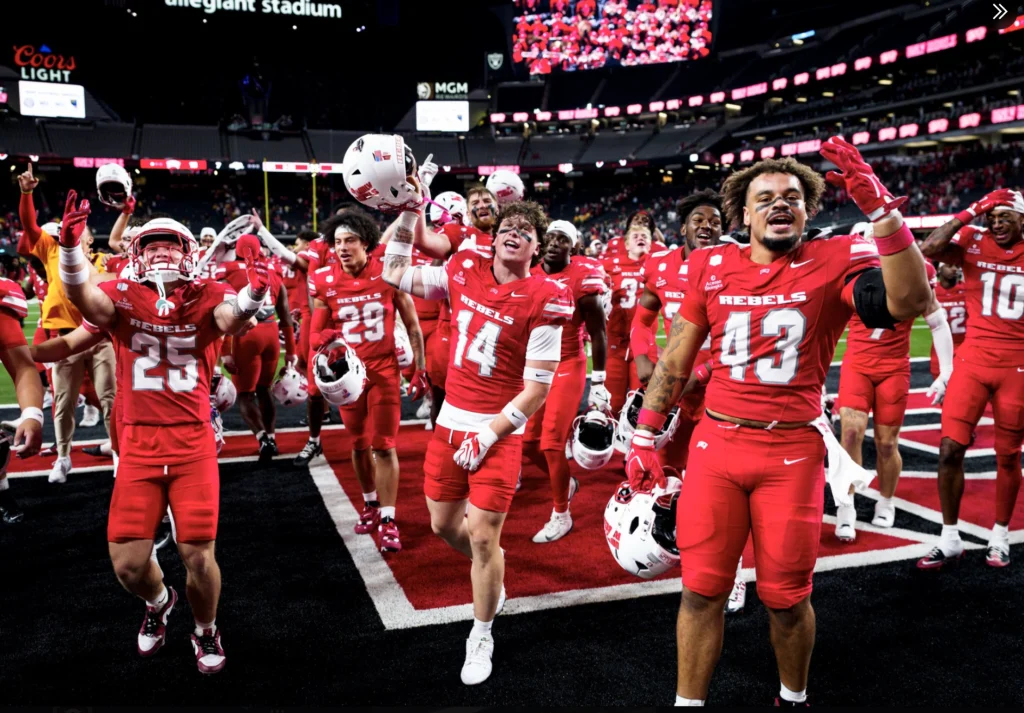
LAS VEGAS — Dan Mullen did not leave UNLV’s 13-7 win over North Dakota State believing Jackson Arnold had nowhere to throw. The Rebels’ passing game had opportunities Saturday, according to their coach, but Arnold did not always take them and the receivers did not always give him a matchup he trusted.
“We were a little conservative with the ball,” Mullen said afterward. “I think there’s some one-on-one matchups I think we missed.”
UNLV won because its defense produced the only Rebel touchdown on Andre Porter’s interception return and Mumu Bin-Wahad added two more takeaways. The offense managed six points, despite moving the ball well enough on the ground to threaten North Dakota State. Mullen’s assessment afterward centered on why those opportunities ended without a touchdown.
Arnold completed eight of 16 passes for 77 yards and threw his first interception of the season. A week earlier against California, he had accounted for five touchdowns, including a 70-yard pass to Kayden McGee and a 36-yard score to Taz Reddicks. The Bison prevented a repeat, but Mullen did not believe every missed opportunity was forced by the defense.
“We gotta do a better job winning on the outside for him to wanna throw that ball to the receivers,” Mullen said.
North Dakota State had shown in earlier games that defensive coordinator Grant Olson could threaten pressure before dropping defenders underneath routes. On UNLV’s second-quarter possession, Kelton McCaslin hurried Arnold on an incomplete deep throw intended for Keyan Burnett. On the next play, Arnold threw toward Tavian McNair, and Ray James Jr. intercepted it. The play-by-play confirms those consecutive plays, but not which coverage Arnold saw or what caused the interception.
UNLV converted five of 15 third downs and produced only one completion of at least 15 yards. The 28-yard catch by McGee came in the fourth quarter, long after it had become clear North Dakota State would make the Rebels put together multiple successful snaps to move the ball.
Mullen’s comments leave two things to examine. An outside receiver may have one defender across from him without having enough separation for a throw, while Arnold still has to decide when to trust that matchup. Mullen believed opportunities were missed, but he did not identify the particular routes or coverage reads. The broadcast and game report do not establish which player was responsible on every missed chance.
With Austin Boyd out because of an ankle injury, Griffin Scroggs logged 66 snaps at center and Colton Thomasson played 54 at left guard, according to the blocking snap-count report. Receiver DeAngelo Irvin Jr. was also unavailable. The personnel changes provide context, but UNLV had already scored 38 points against Akron and 39 against Cal while managing injuries. The missed passing opportunities cannot be attributed to those absences alone.
The running game gave Mullen another reason to believe his offense could have scored more. Jai’Den “Jet” Thomas carried 22 times for 112 yards, while Arnold added 60 net rushing yards. UNLV finished with 178 against a defense that had allowed 102.2 rushing yards per game entering the weekend. North Dakota State had not let many opponents move the football that way.
Mullen credited his players for matching the Bison’s physicality, something he said began with the way UNLV’s offense and defense competed against each other during the week. But those rushing gains never produced an offensive touchdown. Both trips into the red zone ended with field goals, leaving an afternoon of productive runs with little to show on the scoreboard.
Thomas was responsible for much of the third-quarter possession that broke a 7-7 tie. He opened it with gains of 15 and seven yards, and Arnold added a 15-yard keeper. The Rebels reached scoring range, but the drive ended with Ramon Villela’s 29-yard field goal. That gave UNLV the lead without offering much protection against one more North Dakota State touchdown.
The clearest example of what Mullen wants corrected came after UNLV’s defense handed the offense the ball at the North Dakota State 18 early in the fourth quarter. The Bison had elected to go for fourth-and-1 at their own 17, but Cam Santee and Kamuela Ka’aihue stopped Myles Mitchell for no gain. UNLV took over already within striking distance.
Thomas gained four yards on first down and seven on second, moving the Rebels to the 7. Mullen then called outside zone for Arnold on first-and-goal. The Bison set the edge, forcing Arnold to look for a lane back inside. Before he could make that cut, he fumbled and recovered the football at the 8.
“They did a great job setting the edge,” Mullen said. “He tried to cut, and then, you know, I think he had a lane, but he fumbled the ball.”
Arnold followed with a seven-yard keeper, bringing UNLV to the 1. A delay-of-game penalty pushed the Rebels back to the 6, and a pass intended for Reddicks fell incomplete after Jaylin Crumby broke it up. Villela made the 24-yard field goal, putting UNLV ahead 13-7. The defense had supplied an excellent scoring opportunity, Thomas had carried the ball to first-and-goal and the Rebels still settled for three points.
Mullen said UNLV might have been better served continuing to feed the runner near the goal line. He also believed Arnold could have reached the cutback lane on the outside-zone play without the fumble. Those were decisions and mistakes his staff could actually examine and correct, rather than simply crediting North Dakota State for stopping the offense.
“I think you’re disappointed in the touchdowns in the red zone,” Mullen said.
The next-day film review should be particularly uncomfortable because UNLV created some of its own difficult situations. The Rebels were penalized nine times for 94 yards. Mullen said several of the mistakes involved receivers lining up incorrectly, the kind of problem that turns a manageable down into an obvious passing situation against a defense built to win those snaps.
“We had too many mistakes that hurt ourselves,” Mullen said. He also took responsibility for a substitution penalty. “The last penalty is on me. The substitution one.”
North Dakota State’s defense deserves credit for making those mistakes costly. Its front recorded two sacks and five tackles for loss, while Olson’s changing looks demanded that Arnold confirm what the defense was doing instead of relying on its initial alignment. But Mullen’s comments suggest the staff will be studying more than protection failures. The quarterback’s willingness to challenge single coverage, receiver separation and the sequence of calls inside the 10 all belong in the same conversation.
The Bison had their own short-yardage decisions to revisit. Earlier, following James’ interception of Arnold, North Dakota State drove inside UNLV’s 10 before Jake Pope and Justin Flowe stopped Nyeoti Punni on fourth down. The later failed attempt by Mitchell at the Bison 17 gave UNLV the possession that produced its final points. North Dakota State had used aggressive fourth-down decisions successfully during its unbeaten start, but went 0-for-2 on Saturday.
That did not mean UNLV’s front controlled the entire game. Mitchell returned after missing the Wyoming game and rushed for 91 yards on 22 carries, while DJ Scott, the Bison’s leading rusher entering Saturday, had only three attempts. North Dakota State still gained 176 yards on the ground, showing how effectively offensive coordinator Dan Larson could rotate runners without abandoning his running concepts.
Polasek had warned that Paul Guenther’s defensive fronts could create difficult protection decisions. The Rebels recorded two sacks, including fourth-quarter pressure from Porter and Dee Crayton, and Bin-Wahad’s final interception ended North Dakota State’s last chance. The game report identifies the plays that stopped the Bison. It does not establish which protection or coverage call caused each one.
Porter’s contribution included something the game report could never explain. After returning the first-quarter interception 23 yards for UNLV’s touchdown, the Las Vegas native said the same situation had come up during the final days of preparation.
“Honestly, I was surprised I caught the ball,” Porter said. “I actually did the same thing in practice on Thursday. So practice how you play.”
That preparation gave UNLV seven points before its offense found any rhythm. Mullen believed the early deficit mattered because North Dakota State was accustomed to playing with the lead and relying on its running game. The Bison still moved the football well enough to put the result in doubt, but three interceptions prevented them from cashing in on those possessions.
The Rebels avoided the special-teams breakdowns that nearly derailed the Cal victory. Villela missed from 45 yards in the first quarter before making both second-half field goals, and Peyton Zachary’s 27-yard punt return helped set up the first. North Dakota State kicker Drew Klein, previously 9-for-9, missed from 53 yards before halftime. In a game decided by six points, UNLV at least converted the opportunities its offense managed to create.
UNLV takes a three-game winning streak into its Oct. 17 trip to Air Force. Before then, Mullen and his staff have to review the passing chances he believes Arnold and the receivers missed, along with the penalties that interrupted two red-zone possessions.
See something that needs correcting? Report a correction.