

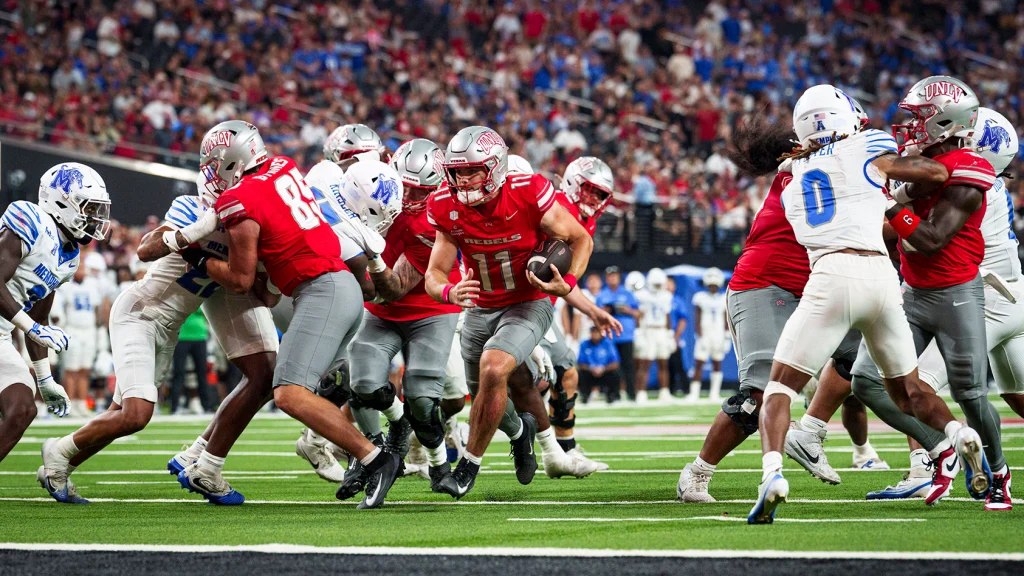
LAS VEGAS — UNLV’s defense held North Dakota State to seven points and scored the touchdown that won the game. On Saturday, it faces an Air Force offense that just rushed for 439 yards, while Jackson Arnold and offensive coordinator Corey Dennis try to get the Rebels back into the end zone.
The Falcons can put a fullback through the middle, pitch to a receiver outside or send Evan Medders into either opening. Their defense has allowed 16 points over its last two games. Senior linebacker Blake Fletcher has led Air Force in tackles in all five games and intercepted two passes in the red zone, where UNLV has scored touchdowns on fewer than half its trips.
The Rebels are 4-2 and 2-0 in the Mountain West after consecutive wins over Akron, Cal and NDSU. Air Force is 4-1 and 2-1, with its own three-game winning streak. Kickoff is Saturday at 12:30 p.m. PT at Falcon Stadium, with television coverage on CBS Sports Network.
A win would send UNLV into its bye at 3-0 in conference play, with Northern Illinois next on Oct. 31. Air Force can move to 3-1 and hand the Rebels their first league loss. Both have already faced NDSU: the Falcons lost 38-32, while UNLV handed the Bison their first defeat last Saturday.
UNLV has won the last two meetings, but last season’s 51-48 victory required Anthony Colandrea’s touchdown run with 36 seconds remaining. Air Force gained 603 yards, including 428 rushing. Owen Allen accounted for 192 of those rushing yards.
Troy Calhoun spent part of Tuesday’s media availability discussing UNLV’s recruiting credentials and financial resources, comparing the Rebels with baseball’s biggest spenders. He supplied no spending figures. The offense he praised has produced 39 points against Cal and six against NDSU in consecutive weeks.
Dan Mullen’s preparation on defense begins with keeping the Rebels responsible for each runner.
“You gotta be in your gap. And you gotta have your eyes in the right spot,” he said Monday.
Allen, Matt Long and the problem with following motion
Allen gained 100 yards on 13 carries and scored twice in Air Force’s 28-7 win at Northern Illinois. Kemper Hodges and Gage LaDue share the fullback work, carrying inside and blocking for Medders. The same back UNLV has to tackle on one snap can lead the quarterback toward another defender on the next.
The formation alone will not identify the play. Flexbone puts Medders under center with a fullback behind him and slotbacks outside the tackles. On a triple option, the quarterback can give inside, pull the ball and then decide between keeping it and pitching. A called handoff or a two-way keep-or-pitch play can begin from a similar look without giving him all three choices.
UNLV’s defenders have to read the blocks along with the backfield. If an end closes on the fullback during a read play, Medders can pull the ball. The defender responsible for the quarterback then has to stay available without carrying the pitch defender inside with him. Defensive coordinator Paul Guenther assigns those responsibilities within his call.
The fullback can also become the blocker who makes the quarterback run work. On Medders’ four-yard touchdown at NIU, the broadcast identified Hodges supplying a block. Hodges was in front again on Medders’ 41-yard score, with Long moving across the formation before the quarterback ran around the right side. Medders said the longer touchdown followed a coaching check. The Falcons can change the call after UNLV lines up.
Matt Long makes the outside assignment just as difficult. Listed as a receiver, he carried seven times for 76 yards against the Huskies. On the opening touchdown drive, his pitch carries gained 11 yards on second-and-five and five on third-and-four. Within the same possession, Medders gained seven and four yards on consecutive shotgun carries through the middle.
“The team’s going to go where the offensive line goes,” junior offensive lineman Jon Ashworth said Tuesday.
One of Long’s pitches came behind an unbalanced line, with the blockers distributed differently across the formation. UNLV has to adjust its front before defending the run.
Jake Pope, Cam Santee and the defenders around them cannot let the perimeter threat pull everyone out of the middle. On Allen’s 33-yard touchdown at NIU, CBS Sports Network analyst Robert Turbin pointed to linebacker Jack Murray following Rocco Conti toward the outside. Allen took the ball through the opening inside.
Andre Porter and Kal-El Togafau have supplied pressure and negative plays. Saturday requires them to recognize when Air Force is blocking them and when Medders is reading an unblocked defender. An end closing on the fullback can give the quarterback room to keep.
UNLV has allowed 13 points in its two conference games. Its run defense has allowed 141.3 yards per game and 4.2 per carry through six games. NDSU still gained 176 on the ground, including 91 on 22 carries by Myles Mitchell. The seven points allowed came from ending possessions with takeaways and fourth-down stops, rather than shutting down every part of the running game.
Porter and Togafau earned Mountain West honors after the NDSU win. Togafau had six tackles; Porter supplied the interception touchdown, a sack and a forced fumble. Against Air Force, an end who holds his position can help prevent a long run without appearing in the tackle totals.
Make Medders throw without losing him outside
Medders will make his second career start after replacing Liam Szarka, who suffered a season-ending leg injury. He ran for 114 yards and two touchdowns at NIU, including a 41-yard score. He also had the benefit of an offense that repeatedly gained enough on early downs to keep running.
Calhoun planned opportunities for Medders before Szarka’s injury. After the opener, he discussed getting him into games early when the situation allowed it. By Reno week, he described those snaps as an investment.
“Just trust that preparation,” Calhoun said of his message to Medders.
Air Force converted 10 of 13 third downs at NIU and finished with one official pass attempt, Hodges’ fourth-down incompletion near the goal line. Medders did look to throw on second-and-one before Brady Kerperin sacked him for a six-yard loss. His four-yard run on third-and-seven left Air Force punting.
That possession shows what UNLV needs from a negative play. Sacks do not count as pass attempts, but they can make the next run insufficient to keep a drive alive. Medders has yet to be tested over a full start in which Air Force repeatedly needs him to complete passes.
UNLV has 16 sacks, but its NDSU performance also supplied a warning. On third-and-11, a twist up front lost outside contain, allowing Nathan Hayes to escape and find Reis Kessel for 28 yards. Pope and Tre Fulton must stay with the receivers behind the rush while the front keeps Medders from taking a similar opening.
Simon Kibbee is particularly important behind those linebackers. Against Navy, Air Force used a formation and motion it had previously shown on speed option, then threw to the tight end up the seam. Calhoun explained afterward that Kibbee could adjust his route for a quicker throw if a linebacker blitzed.
Szarka made that throw. Medders still has to show he can execute it, but UNLV cannot leave Kibbee behind a blitzing linebacker while finding out.
Johnique Thomas made his first career start at center against NIU. Calhoun credited his identification of odd and even fronts, with different alignments within each. Guenther can test that communication by changing the front before the snap, provided the Rebels remain clear on their own assignments.
Arnold and Thomas against Fletcher
Fletcher has helped turn promising opposing drives into empty possessions. At NIU, he intercepted Taron Dickens near the goal line and later stopped a fourth-and-one run at the Air Force 13.
Jai’Den Thomas enters with 495 rushing yards at 5.2 per attempt after gaining 112 against NDSU. Arnold has another 330 rushing yards and five touchdowns; his official rushing total includes sacks.
On Arnold’s 19-yard keeper against the Bison, Ray James Jr. closed toward the running back and Arnold took the space outside. Air Force has to account for both carriers. Dennis and Mullen can use that conflict to create a throwing opportunity behind a linebacker who moves toward the run.
Mullen’s decision to lean on the run against NDSU had a coverage explanation. The Bison played softer zones to limit the downfield throws UNLV had hit against Cal. Thomas and Arnold gained ground underneath that approach, and Mullen used the run to protect field position while the defense held the lead.
If Fletcher and the safeties begin moving toward the run, Arnold needs to use the space behind them. If the Falcons keep defenders back, UNLV needs enough from Thomas and Arnold to make that choice costly without forcing a downfield throw into coverage.
Protection still determines how much of that choice Arnold gets to make. PFF charted pressure on 16 of his 24 dropbacks against NDSU. Across those 24 dropbacks, he scrambled six times and took two sacks. His running helped the Rebels preserve possessions, but the passing game finished with 77 yards.
Air Force outside linebacker Dallas Daley creates another protection question. Describing a sack against NIU, Daley said he was assigned to the back before recognizing an opportunity to rush. The broadcast described him catching Dickens around the ankles as the quarterback tried to escape. Arnold can extend a play, but a defender does not have to arrive cleanly to get him down.
If the defender covering a back joins the rush when the back stays in protection, UNLV has to account for him after the snap. Receivers also have to keep working when Arnold leaves the pocket.
Daley is not the only threat beyond the defensive line. Jaylin Reese recorded 1.5 sacks against Reno, and safety Max Mustell had a 10-yard fourth-quarter sack against Navy. UNLV’s protection has to account for pressure from those positions as well as the line.
Austin Boyd’s recovery remains relevant to that protection. Mullen said Monday that the center was ahead of the medical staff’s expected schedule, but he did not announce a return date. Mullen also said Jaylon Glover had been available against NDSU, giving the backfield an option beyond the rotation used most heavily in that game.
The receivers have to make Air Force defend them
In NDSU’s win at Falcon Stadium, Mekhi Collins took a short fourth-and-two completion through attempted tackles for a 44-yard touchdown. Logan Conklin scored on a 41-yard downfield catch with a defender close enough to contest the finish.
PFF’s six-game receiving report has Taeshaun Lyons, Tavian McNair, Vincent Carner and Troy Stellato combining for 21 catches and 252 yards, with only 32 yards after the catch. All four have primarily lined up outside on passing snaps. Those completions have usually left the offense needing another successful play.
Kayden McGee has shown the value of beating the first tackle. His 70-yard touchdown against Cal included a broken tackle before he accelerated away. Taz Reddicks has supplied downfield gains, too, but both receivers have worked predominantly from the slot. UNLV needs production across the formation when Air Force directs attention toward its most productive targets.
There are opportunities against Air Force’s coverage. NIU’s touchdown drive included completions of 21 and 18 yards to DeAree Rogers before a quarterback run and Telly Johnson Jr.’s scoring carry. The Huskies made the Falcons defend through the air before finishing on the ground.
Air Force safety Alexander Perez said the returning secondary has grown more comfortable working together.
“Our communication’s way better than it was last year,” Perez said Tuesday.
He pointed to recognizing run and pass more quickly and improving his man coverage. Perez also identified stopping the run on first and second down as a way to get UNLV into longer third downs.
Thomas can help the passing game without waiting for a broken tackle outside. At Akron, UNLV aligned most of its receivers toward the short side and released him up the opposite sideline for an uncovered 40-yard touchdown.
The shorter passing game has supplied much less. Through six games, PFF charts 11 screen attempts producing seven completions and nine yards. After North Texas, Mullen criticized perimeter blocks that had kept potential long gains short. Calling a screen to slow the rush only helps if the receiver or back can get beyond the first defender.
Can UNLV trust Arnold and Dennis when it needs a touchdown?
Arnold has already helped UNLV win a game after the offense lost its lead. Against Cal, he ran for 42 yards on the possession that ended with his third-and-eight touchdown pass to Keyan Burnett. The Rebels went 80 yards in five plays and took the lead back.
Dennis and Mullen deserve credit for that response. UNLV has also scored six points at North Texas and gone without an offensive touchdown against NDSU. The offense has not repeated the Cal execution often enough to make another winning possession dependable.
Arnold’s eight touchdown passes against one interception give UNLV a reason to keep the ball in his hands. PFF has charged him with five turnover-worthy plays, all under pressure. Those include dangerous throws or avoidable fumbles, whether the defense recovered the ball or not. His mobility has rescued possessions, but it does not remove the need to deliver an available throw before the play breaks down.
Dennis’ responsibility is to give him calls he can execute against the defense he is seeing. After North Texas, Mullen described reviewing a throwing window the coaches liked and having to understand why Arnold had not used it.
“I might like a play, but if he’s not comfortable running it, it really doesn’t matter what I like,” Mullen said.
Dennis coaches the quarterbacks as well as coordinating the offense. Arnold needs a practiced response when Fletcher stays underneath the first route, a safety closes a window or another defender joins the rush. If a throw is open, he has to trust it and deliver.
The staff also has to stay with productive players near the goal line. Thomas covered 14 yards on two carries after UNLV took over at the NDSU 18, then did not touch the ball again on that possession. The Rebels settled for a field goal. Arnold’s running should expand the choices available to Dennis and Mullen, rather than make the quarterback responsible for finishing every drive himself.
“We didn’t play great offense,” Mullen said Monday.
Arnold has given UNLV reasons to trust his ability. Dennis and Mullen still have to make the offense dependable enough that a penalty, a missed throw or a loss on first down does not leave the rest of the possession on the quarterback’s legs.
Finishing the possession
The Rebels have scored touchdowns on eight of 17 red-zone trips.
Calhoun said defensive coordinator Steve Russ and his staff install third-down and red-zone packages early enough in the week to prepare for the fourth down that might follow. Fletcher’s stops against NIU came after the Huskies had already moved into scoring range.
Air Force also left points behind at NIU. A 17-play drive used 10:31 and ended with Hodges’ fourth-down incompletion from the 2. UNLV may have to defend that long and still win the last snap.
The Rebels have allowed opponents to convert two of nine fourth-down attempts. Against Air Force, a tackle short of the marker on third down may leave another run to defend.
Field position can reduce the amount of work UNLV asks of its offense. Peyton Zachary’s 22-yard punt return against NDSU was the Rebels’ longest since 2024. Ramon Villela has made six of eight field goals this season.
Penalties can erase that field-position work. UNLV has averaged 71.5 penalty yards per game, and the delay near the goal line against NDSU made a short scoring opportunity harder.
Mullen’s clock decisions can preserve an offensive opportunity, too. At NIU, Air Force scored before halftime and received the second-half kickoff, leaving the Huskies with one official offensive snap between Falcons touchdowns. If Air Force is due to receive after the break Saturday, UNLV has to weigh using its timeouts on defense while enough time remains for Arnold to answer.
The Rebels also cannot assume Air Force’s exchanges will give them a turnover. The Falcons have not fumbled in 366 plays this season.
UNLV’s defense scored its only touchdown last Saturday. At Air Force, the Rebels need Arnold and the offense to finish a drive before asking that defense to stop another one.
See something that needs correcting? Report a correction.