

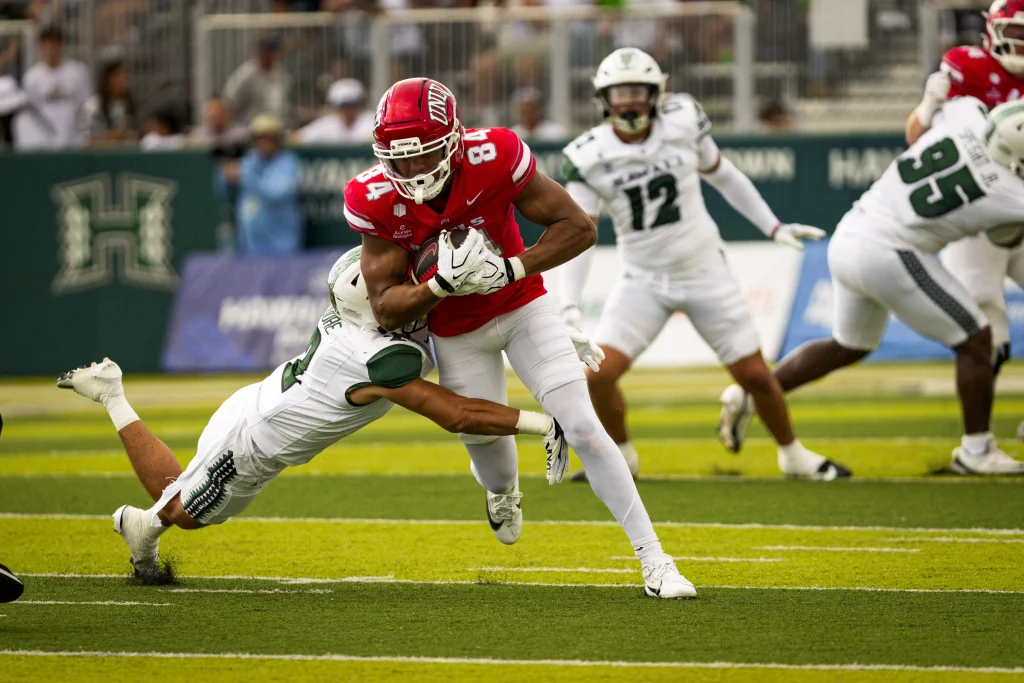
LAS VEGAS — Keyan Burnett has given UNLV something it needed entering 2026: a tight end who can make an impact in the passing game. Air Force asks considerably different things of Simon Kibbee, Mitchell Blakeslee and Griffin Stalfort. Their blocking responsibilities help make the Falcons’ option offense work, and judging the groups only by catches would miss much of the comparison.
Burnett caught three passes for 55 yards against Hawai‘i, leading UNLV in receiving during a 21-6 victory. The Rebels also ran for 248 yards on 43 carries while using multiple-tight-end formations. Air Force’s tight ends are part of a ground attack that entered the UNLV matchup averaging 325.6 rushing yards per game. The question is which group performs its assigned jobs better, not which offense throws more often.
UNLV needed Burnett’s receiving production
The Rebels entered the season replacing the tight end production of Var’Keyes Gumms and Nick Elksnis. The position produced 25 catches, 337 yards and five touchdowns in 2025, but returning players Matt Byrnes, Velltray Jefferson and Jae Beasley II combined for only two receptions, both by Byrnes. Burnett arrived after stops at Kansas and Arizona as the player most likely to change that imbalance.
At 6-foot-6 and 250 pounds, Burnett offers Arnold a sizeable target without requiring UNLV to abandon heavier personnel. His three catches against Hawai‘i mattered in a game where the Rebels leaned on the run and generated little passing production elsewhere. His role is no longer merely an offseason projection. The question for the room is whether Byrnes, Jefferson and Beasley can make enough contributions as blockers and receivers to prevent opponents from identifying the play through substitutions.
The Rebels’ 248 rushing yards against Hawai‘i demonstrate the offense can run productively with additional tight ends on the field. They do not prove each tight end won his assignment. Individual blocking grades require knowing who was responsible for the defensive end, linebacker or edge defender on each play. That distinction matters when comparing the Rebels with a team that asks its tight ends to block so frequently.
Air Force’s blocking responsibilities are not secondary
Kibbee is listed at 6-foot-5 and 250 pounds, Blakeslee at 6-foot-4 and 260 pounds, and Stalfort at 290 pounds. Their size fits an offense built on creating lanes inside and along the perimeter, but their effectiveness cannot be determined from measurements. The Falcons need blockers who recognize the front, secure leverage and get to the correct defender while the quarterback and backs carry out their assignments.
Our Air Force offensive breakdown showed why those details are so important. Against Northern Illinois, the Falcons used fullbacks as both runners and lead blockers, shifted the ball from interior runs to outside pitches and moved receivers across the formation to influence defensive fits. Evan Medders rushed for 114 yards and two touchdowns in the 28-7 win, while Air Force finished with 439 rushing yards. Tight end assignments are part of that coordinated blocking effort, although the available play descriptions do not isolate individual blocks by Kibbee, Blakeslee or Stalfort.
The Falcons’ offense is not limited to the traditional under-center triple option. Air Force also runs from shotgun, uses called quarterback carries and sends backs and receivers toward different gaps. An inline tight end can have to seal a defender on one snap and help create a perimeter lane on the next. The blocker must know whether a defender is being blocked or deliberately left for the quarterback to read. A missed assignment can disrupt the timing of the entire play.
Kibbee is more than an extra blocker
Air Force’s passing game gives Kibbee an important role of his own. He had six receptions for 103 yards through five games, and our existing Air Force scouting documents how those catches were created. Against Reno, Liam Szarka completed a 19-yard pass to Kibbee after a 15-yard shotgun run, then found him for 34 yards on a later scoring possession. The Falcons did not abandon the run; they made the defense account for the tight end between rushing plays.
Against Navy, Szarka found Kibbee for 23 yards on fourth-and-four, setting up an eight-yard quarterback touchdown run on the next snap. Our game preview also documented a seam concept against Navy in which Air Force showed formation and motion it had used for speed option before throwing to Kibbee. Calhoun explained afterward that Kibbee could adjust his route for a quicker throw if a linebacker blitzed. That is a specific passing-game responsibility, not merely a large player leaking into open grass.
The same threat remained in the playbook after Szarka’s season-ending injury. Against NIU, fullback Kemper Hodges took a direct snap and attempted a fourth-down jump pass toward Kibbee in the end zone. The broadcast described Kibbee as open, but the pass sailed over him. The failed play still showed that Air Force was willing to involve its tight end in a passing call from an unconventional backfield look. Medders, making his first start, did not attempt an official pass that game, so UNLV still had limited evidence of how he would execute the Falcons’ passing concepts.
Where UNLV has the advantage
Burnett has become a more established part of a conventional passing attack, and UNLV can pair that receiving threat with personnel packages designed to support its rushing game. The Rebels’ game preview also documents a third-and-eight touchdown pass from Arnold to Burnett against Cal, finishing an 80-yard, five-play possession in which Arnold had already gained 42 yards on the ground. Burnett’s value there was not hypothetical: he finished a drive when UNLV needed a touchdown.
That gives UNLV a credible receiving advantage, but it does not settle the blocking comparison. Air Force’s tight ends are central to an offense that demands precise assignments across several rushing concepts. UNLV’s group has a different workload, including pass protection and route responsibilities. A complete grade would chart alignments, blocking assignments, missed blocks, routes and targets for both teams, rather than awarding a win because one player has more catches.
The verdict
UNLV gets the narrow preliminary edge because Burnett has delivered the receiving production the Rebels were missing, while the room can still participate in heavier running formations. Air Force has a legitimate counterargument in its blocking demands and in Kibbee’s demonstrated ability to convert important passing downs. The Falcons’ tight ends should not be treated as lesser players simply because the offense asks them to catch fewer passes.
The margin depends on Burnett. If the rest of UNLV’s room cannot consistently execute its assignments, the Rebels’ apparent versatility becomes a one-player advantage. Air Force has already shown that Kibbee can punish defenses that focus entirely on the option. UNLV has the more established receiving weapon; whether it has the better blocking group remains an open film question.
See something that needs correcting? Report a correction.